



44 years after his election, Bachir Gemayel’s election and vision of a free, sovereign, and strong Lebanese state continues resonating across generations.
Bachir Gemayel: The vision that outlived the president
Bachir Gemayel: The vision that outlived the president
By The Beiruter | August 23, 2026

Reading time: 7 min
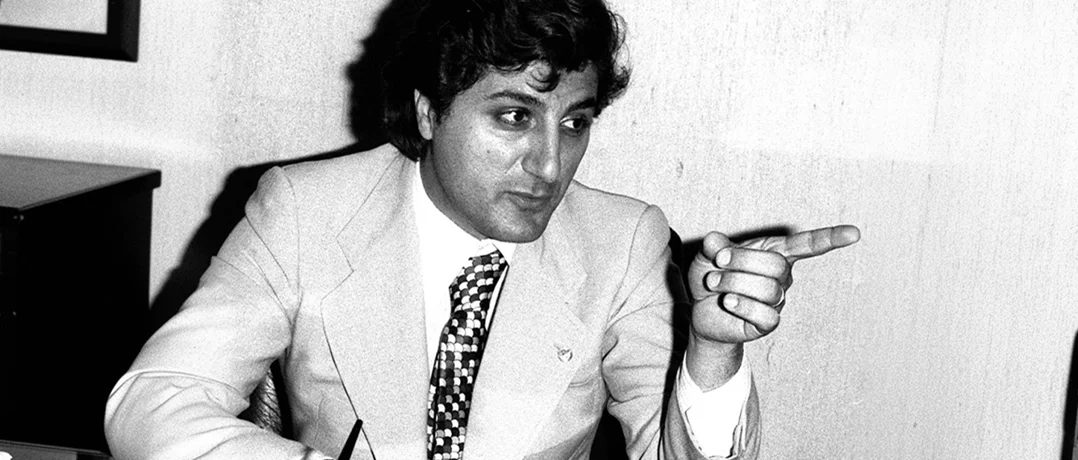
On 23 August 1982, amid one of the darkest chapters in Lebanon’s modern history, the Lebanese Parliament elected Bachir Gemayel as the country’s youngest president. Gemayel embodied, for many Lebanese, the hope of restoring state authority, national sovereignty, and effective governance after years of instability. Although he was assassinated just 21 days later, before formally assuming office, his brief period as president-elect marked a turning point in the Lebanese Civil War (1975-1990) while his vision and political legacy continue to inspire supporters who believe he represented a unique opportunity to rebuild the Lebanese state.
Speaking to The Beiruter on the anniversary of Gemayel’s election, Alfred Madi, President of the “Other Choice” Movement and founder of the Bachir Gemayel Academy, reflected on the political circumstances that led to Gemayel’s presidency, the principles that shaped his political project, and why Bachir’s vision continues to resonate today.
The election was the final step, not the beginning
According to Madi, understanding Bachir Gemayel’s election requires looking far beyond parliamentary arithmetic. “Elections in Lebanon are not simply about collecting votes,” he explained. “They must fit into a broader political and geopolitical strategy.”
For Madi, Gemayel’s emergence as the leading presidential candidate was the culmination of several years of political and military developments rather than a campaign focused solely on securing parliamentary support.
He argued that the 1981 Battle of Zahle represented a decisive moment in Gemayel’s rise. The prolonged confrontation between the Lebanese Forces (LF) and Syrian forces transformed Bachir, in Madi’s assessment, into the country’s most prominent national leader and significantly strengthened his presidential credentials.
What truly made Bachir was that he had become a popular national leader.
Regional dynamics also played a central role. At the time, Lebanon had become an arena where the interests of the United States (U.S.), Israel, Syria, Arab states, and the Soviet Union intersected. Madi described the period as one dominated by two opposing geopolitical camps, arguing that international circumstances increasingly worked in Gemayel’s favor.
By the time the presidential election approached, Madi believed Bachir had already become, politically speaking, the inevitable candidate.
No one else could truly rival him.
While international backing proved essential, Madi stressed that the internal political battle remained equally important. Once the external environment became favorable, attention shifted toward ensuring the parliamentary majority necessary to secure the presidency.
He credited the late Zahi Boustany with overseeing the domestic electoral strategy. According to Madi, Boustany coordinated negotiations among numerous political actors with differing ambitions. While some eventually followed suit in pursuit of parliamentary seats and ministerial portfolios, others simply wanted Gemayel elected because they were loyal to him and believed in his project. “After balancing all these different elements,” Madi noted, “Zahi played the decisive role in assembling the parliamentary votes.”
For Madi, the election itself ultimately represented the final stage of a much longer political process that had been shaped by military developments, international diplomacy, and internal negotiations.
A vision centered on sovereignty, reform, and trust
Beyond the election itself, Madi believed Bachir Gemayel’s enduring significance lies in the political vision he sought to advance.
He explained that what later became known as “Bachir’s dream” emerged from a conviction that Lebanon’s existing political system had failed to preserve both the country’s sovereignty and its social fabric. “The situation had become unbearable,” Madi said, arguing that sectarian politics had weakened the state and left Lebanon vulnerable to external influence.
Bachir, he added, had two crucial questions and concerns in mind:
How do we preserve the Christian presence? And how do we preserve Lebanon?
According to him, Gemayel’s political thinking and his entire political project rested on three interconnected pillars.
The first was preserving Lebanon’s Christian presence, which he viewed as an essential component of Lebanon’s pluralistic identity and coexistence.
The second was building an organized resistance capable of defending Lebanon’s sovereignty during the Lebanese civil war.
The third was achieving what Madi described as “revolutionary political change” through institutional reform and the creation of a capable, trustworthy leadership.
Those objectives, he argued, required more than military organization. They also demanded competent individuals committed to public service rather than personal gain. Madi highlighted what he considered one of Bachir Gemayel’s defining leadership traits: his confidence in those around him. Unlike many political leaders who constantly monitored or doubted members of their own circles, Gemayel, according to Madi, cultivated relationships based on mutual trust.
Political change required a clean, trustworthy team. That is how Bachir built his team.
He recalled how philosopher Charles Malik had once described Bachir’s inner circle as a team built upon complete loyalty toward its leader and complete confidence from the leader toward his collaborators. For Madi, that culture of trust became one of the foundations of Gemayel’s broader political project. “That mutual confidence distinguished Bachir from everyone else,” he asserted.
The image of a disciplined state
Although Bachir Gemayel never formally exercised presidential authority, Madi argued that his election alone generated an immediate psychological transformation within state institutions.
To illustrate this point, he recounted the story of a Lebanese embassy employee in Senegal who had routinely arrived at work late each morning. Following Gemayel’s election, however, the employee reportedly began arriving at work before official opening hours. When colleagues asked why, his response was simple: “There is a President named Bachir now. There is no more joking around.”
For Madi, the anecdote illustrates how Gemayel projected seriousness, discipline, and authority long before taking office. He attributes this perception primarily to Gemayel’s personal integrity. Nor, he added, can a leader expect discipline from public servants without personally embodying those same standards.
You cannot teach people honesty and integrity if you yourself are corrupt.
He also recalled one of Gemayel’s well-known declarations: “What I say, I do. I make promises, and I keep them.” According to Madi, consistency between words and actions distinguished Bachir from many other political figures and helped create widespread expectations that state institutions would once again function according to clear rules rather than personal interests.
Asked whether Bachir would have succeeded had he survived, Madi declined to speculate directly. Instead, he argued that Gemayel’s political record, principles, and leadership style offered sufficient evidence for people to form their own conclusions. “Judge him by his ideas, his message, his project, and his accomplishments,” he said. “Someone who succeeds through his actions, his vision, his principles, and his integrity leaves little room for doubt,” adding that “there was no doubt in my mind that Bachir would have succeeded completely.”
Rather than focusing on one individual, however, Madi stressed that Lebanon today requires an entire generation committed to those same values of integrity, discipline, and public service.
It is not enough to have one Bachir. The important thing is that his path continues.
The road to Baabda
Bachir Gemayel’s election was preceded by years of political preparation that extended well beyond the battlefield. Following the unification of the LF in 1980, he tasked a group of senior political and military figures, including Antoine Najem, with developing a strategy for Lebanon’s next phase. Their deliberations culminated in a series of meetings, most notably the retreat held at the Monastery of Our Lady of El-Bir in September 1980, attended by philosopher Charles Malik alongside leading political, military, and intellectual figures.
The following year, the Battle of Zahle significantly elevated Gemayel’s national profile as LF fighters resisted a prolonged Syrian siege of the city. The confrontation, coupled with growing international attention to Lebanon, strengthened perceptions abroad that Gemayel represented an emerging national leader. His July 1981 visit to the U.S. further enhanced his international standing, while contacts with Western and Arab officials intensified as Lebanon’s crisis deepened.
As President Elias Sarkis’s term approached its conclusion, Gemayel increasingly presented himself as a candidate promising to restore state authority. After Israel’s invasion of Lebanon in June 1982, he simultaneously sought broader domestic legitimacy by engaging Muslim political leaders and visiting Saudi Arabia in an effort to reduce opposition to his candidacy.
On 24 July 1982, Gemayel formally announced his presidential bid. Less than a month later, on August 23, Parliament convened at the Military Academy in Fayadieh. 62 deputies attended the session, including 19 Muslim MPs. After falling short of the required two-thirds majority in the first round, Gemayel secured 57 votes in the second ballot, becoming President-elect of Lebanon.
Forty-four years after his election, Bachir Gemayel remains one of the most influential figures in Lebanon’s contemporary history. While opinions about his political legacy continue to differ, few dispute the profound impact his election had on the country’s trajectory during one of its most turbulent periods. Although his presidency was never allowed to begin, the ideals he articulated continue to resonate with many Lebanese who see in his vision an enduring aspiration for a united, sovereign, and effective state.
-
-

-
The Beiruter
-
