



The weaving and
hurdled path of an internationally celebrated Lebanese pastry chef
From Australia to London: Pastry chef Philip Khoury’s love letter to Lebanon
From Australia to London: Pastry chef Philip Khoury’s love letter to Lebanon
By Grace Massoud | January 17, 2026

Reading time: 5 min
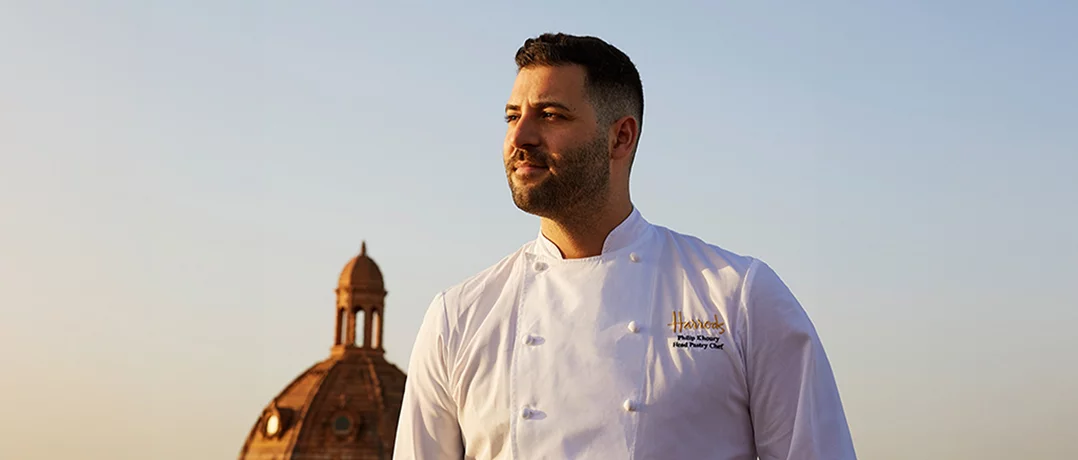
“I thought wow, I was eating it and it hit me, this is what I want to do”. It was while eating the 2000 Feuilles, created by famous French pastry chef Pierre Hermé, that Philip Khoury found his calling.
He was obsessed with the chef, had worked several jobs to save money and go to Paris. When he finally walked into his boutique in Saint-Sulpice and ordered one of everything, he later sat on a bench in front of a cathedral to try the delicacies. The 2,000 praline feuilles took his breath away and the rest is as they say history.
Philip Khoury has been in London for the past seven years as the Head Chef at Harrod’s for six of them; he was born and raised in Sydney Australia. From 2004 till 2006 he lived in Lebanon and went to the Choueifat school in Koura. His Arabic is not too shabby for a guy who hasn’t lived in Lebanon long.
Sinfully delicious combination
The art of pastries is an opportunity to say something. This is where the Beirut chocolate comes in. It was a one-off chocolate bar made for a charity bake sale benefiting young people in Lebanon. He was making a trifle originally, inspired by a memory of a pear recipe, pears from his father’s village in Lebanon.
Someone suggested he make the Dubai chocolate, but since he was raising money for Lebanon, he decided to make the Beirut chocolate instead.
He interpreted a big trend in this chunky textural and indulgent confection. “Putting the crunchy component with a flavor that’s very popular is very clever”, says Philip. So, he mixed baklava and orange blossom caramel in a fat bar. He made a bespoke mold with a look that told a story.
The design is based on a real Lebanese stamp from the 40s recalling the glory days. Only 100 chocolate bars were made, and a random video of the process went viral after the bake sale.
“Some people write love letters, I make chocolates”, admits Philip.
Philip was blessed with success professionally, but when he came to Horeca in Lebanon back in March 2025, he felt like a celebrity.
These days, the Beirut Chocolate can be purchased in Lebanon from the airport duty free and from Le Noir Chocolat.
Down a different path
A career in pastries was not always the obvious choice. He got a communications and design degree in Sydney and thought that the world of advertising was it for him. Nevertheless, he was a keen baker, having started at sixteen or seventeen.
During an internship, one of his bosses told him: “Did you ever consider a career as a pastry chef?”, to which he responded: “Are you saying I’m a bad designer?” Naturally, the boss reassured him that he thought he was simply a very good baker. That moment opened his eyes to a career in pastries.
Due to his background in communications and design, he doesn’t merely create a dessert because it looks nice or fashionable, “I make something with a purpose. Every single thing you put on a page has to say something”, says Philip. This is how he was trained, and he approaches baking in the same way.
The magician’s hat
His best job so far was Head Pastry Chef at Harrod’s, wrapping six years last February. However, his favorite gig was with chef Adriano Zumbo, the Australian Willy Wonka. He’s creative, successful and has fun with colorful pastries, macarons, and 12 shops in Australia.
Within three months of working with him, Philip took part in two competitions, excelled, then chef Adriano pulled him out of the kitchen and made him his right hand. He developed the works for the whole business over three years. “It was like a magician taking me behind the curtain and showing me everything”, says Philip. He executed all types of products from macarons and chocolates to patisseries, and viennoiseries, ninety different products. It was the most comprehensive role he had, which set him up for the job at Harrod’s.
There are few businesses in the world who offer quality, volume and a wide range of products. 120 different items, thousands of pieces leave the kitchen daily in Zumbo.
Similarly, Harrod’s is one building with 200 varied items produced daily, servicing huge food holes with 60% of their output, and 40% going to twenty-seven restaurants within Harrod’s.
A flawed quest for perfection
While he learnt valuable skills from experience, he witnessed the harshness of the industry as well. The quest for perfection compromised individuals. “There have been times when the working conditions of the people making the pastries were horrible”, says Philip with dismay.
The biggest lesson was that people come first, the ones making the desserts cannot be forgotten.
As a young chef, it was the case for him, and it was the cost of learning. There were three years when he didn’t see his family. Looking back, he was ok with it, but it wasn’t sustainable.
Online since July, Philip’s business will have a shop in London next year. He is on a mission now to create the kind of environment he didn’t have. “I want there to be balance, I want there to be fairness, I want them to be paid well”, confesses Philip.
You go into business to make money, but at the same time if you can’t be responsible towards people, I see that as a failure.
After finishing a few consulting jobs, publishing his second book “Beyond Baking” and traveling the world to promote it, he is most excited about setting up his new business and incorporating his treasured Lebanese culture in his sweets with its amalgam of rich flavors. Many more visits to the country are in the cards for the young chef who garnered success with his people.
-
-

-
Grace MassoudWriter and Head of PRFocusing on general entertainment.
-
