



From Beirut to Moscow: A shared history through language
From Beirut to Moscow: A shared history through language

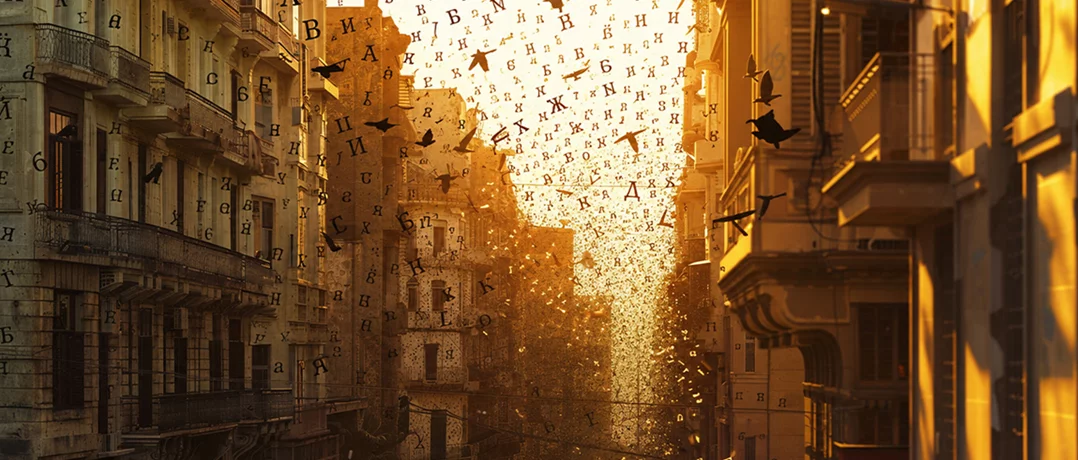
Language often preserves connections that political history overlooks.
More than 450 Arabic-derived words have been absorbed into Russian vocabulary, a linguistic testament to centuries of exchange between two worlds often portrayed as geographically and culturally distant. According to a study published in the International Journal of Oriental Studies (IJORS), these borrowings entered Russian through multiple pathways, such as direct contact with Islamic civilization as well as intermediary languages including Turkic, Spanish, French, German, and Polish. Their presence reflects a long history of interaction that predates modern geopolitics and stretches across trade, scholarship, religion, migration, and education.
This vocabulary tells only part of the story. From Arabic loanwords embedded in Russian speech and the enduring presence of Russian-speaking communities in Lebanon to Soviet-era educational exchanges and the continued role of Arabic within Russia's Muslim communities, these intertwined histories reveal a relationship forged over centuries through migration, learning, faith, and cultural exchange.
The scale of those links remains striking. Russia is home to one of Europe's largest Muslim populations, numbering approximately 20 million people. Lebanon, meanwhile, hosts one of the Middle East's most established Russian-speaking diaspora communities, with estimates ranging from 10,000 to 37,000 residents of Russian or broader Russian-speaking origin. Between them stands a shared educational legacy forged during the Cold War, when Lebanese students joined their peers from across the Arab world in studying at Soviet universities, carrying Russian language skills and cultural familiarity back to their home societies.
As World Russian Language Day is observed on June 6, these overlapping histories offer a reminder that Russian and Arabic have never existed in isolation from one another. Their points of contact can be found not only in dictionaries, but also in places of worship, family histories, and communities that continue to bridge the two linguistic worlds today.
Arabic words in Russian
The significance of Arabic influence on Russian lies not simply in the number of words involved, but in what those words reveal about centuries of interaction between the Russian lands and the broader Islamic world.
According to the IJORS study, Arabic-derived vocabulary appears across an unusually broad range of fields, from science and commerce to navigation and everyday life. Among the examples identified are the Russian words алгебра (algebra), алкоголь (alcohol), тариф (tariff), адмирал (admiral), магазин (store), and кофе (coffee), all of which ultimately trace their origins to Arabic. Over time, these words became fully integrated into Russian and today are rarely perceived as foreign borrowings.
Their presence reflects Russia's historical position at the intersection of Europe and the Islamic world. Some terms entered Russian through contacts with Turkic Muslim peoples along the Volga region and Eurasian steppe. Others arrived through commercial networks linking Eastern Europe with the Caucasus, Central Asia, the Ottoman Empire, and the Mediterranean. Scientific and mathematical terminology often followed a different route, passing from Arabic scholarship into European languages before eventually entering Russian.
What emerges is not evidence of a single episode of cultural exchange but a linguistic record of several centuries of interaction. Trade, diplomacy, religious contact, imperial expansion, and the circulation of knowledge all left their mark on the language. Long before modern political relations emerged, these encounters had already embedded traces of the Arabic-speaking world within everyday Russian speech.
Arabic and Russia's Muslim communities
If Arabic entered Russian through historical contact, it continues to occupy a living place within Russia through the country's Muslim communities. According to former Carnegie Endowment for International Peace scholar Alexey Malashenko, Russia's Muslim population represents one of the most significant and frequently misunderstood components of the Russian Federation.
Unlike many Western European countries, where contemporary Muslim populations are largely associated with recent immigration, Russia's Muslim communities are deeply rooted in local history. Tatars, Bashkirs, Chechens, Ingush, Avars, and numerous other ethnic groups have practiced Islam for centuries. In regions such as Tatarstan, Bashkortostan, Chechnya, and Dagestan, Islamic traditions form an integral component of local cultural life.
Within these communities, Arabic occupies a unique position. While Russian serves as the primary language of public life and administration, Arabic remains the language of the Qur'an, religious scholarship, and theological learning. Generations of Muslims across Russia have therefore encountered Arabic through religious education, prayer, and study of scripture.
The result is a distinctive linguistic environment in which Arabic religious terminology frequently appears within Russian-language discourse. Terms such as imam (имам), mufti (муфтий), hajj (хадж), halal (халяль), sharia (шариат), and dua (дуа) are widely used in religious institutions, publications, and everyday conversations among practicing Muslims. Many of these words have become familiar even to Russians outside Muslim communities.
This interaction has created a linguistic bridge that connects contemporary Russian society to broader Islamic intellectual traditions extending far beyond Russia's borders. In this sense, Arabic is not simply a foreign language within Russia. For millions of Russian Muslims, it remains a living language of faith, learning, and communal identity.
Lebanon's Soviet-Era educational connection
For many Lebanese, Russian entered daily life not through migration or religion, but through higher education.
One of the Soviet Union's most ambitious international projects was its effort to educate students from newly independent states across Asia, Africa, and the Middle East. Historian Constantin Katsakioris, writing in the Journal of Global History, describes the establishment of Patrice Lumumba University in Moscow in 1960 as a central component of this strategy.
The institution was designed to train future engineers, doctors, economists, teachers, scientists, and political leaders from the developing world. In its earliest years, engineering students accounted for 29 percent of enrollment, while medicine represented 20.3 percent and economics and law 17.1 percent.
Lebanese students formed part of this wider educational movement. Throughout the Cold War, young Lebanese traveled to Moscow and other Soviet cities to pursue university degrees, particularly in technical and scientific disciplines. For many, this represented not only an educational opportunity but also an immersive encounter with Russian language, culture, and society.
The legacy of these exchanges remains visible today through organizations such as the Alumni Association of Universities and Institutes of the USSR in Lebanon that continue to connect former students. Many Soviet-educated Lebanese returned home as physicians, engineers, academics, and public servants, carrying with them professional expertise, Russian language proficiency, and personal ties forged during their years abroad. In doing so, they helped create enduring cultural and educational links between Lebanon and the Russian-speaking world that outlasted the Soviet Union itself.
The Russian language in Lebanon today
The legacy of these historical exchanges remains visible in contemporary Lebanon.
The Russian-speaking community in Lebanon represents one of the oldest and most institutionally developed Russian diasporas in the Middle East. Its roots extend back to the nineteenth century, when the Russian Empire established a consular presence in Beirut to assist Orthodox pilgrims traveling to the Holy Land. The Imperial Orthodox Palestinian Society, founded in 1882, played a significant role in establishing Russian cultural and educational infrastructure throughout the Levantine region during the late nineteenth and early twentieth centuries.
The Russian-speaking presence in Lebanon grew through successive waves of migration and exchange. Following the 1917 Russian Revolution, White Russian émigrés and political refugees arrived in Beirut, seeking sanctuary from political upheaval. Over subsequent decades, additional waves of migration, intermarriage, professional relocation, and educational exchange expanded the community further.
A 2025 study published in the academic journal Historical Bulletin on the Russian diaspora in Lebanon estimates its size at between 10,000 and 37,000 people, depending on how diaspora membership is defined. The same study describes a highly organized community supported by a network of cultural institutions, alumni associations, educational organizations, and religious bodies. The establishment of the Coordination Council of Russian Compatriots in Lebanon in 2011 further formalized cooperation among these diaspora institutions.
Perhaps most importantly, Russian has become embedded within Lebanese family life. Thousands of mixed Russian-Lebanese families have created bilingual and bicultural households where Russian is transmitted not only through formal institutions but through ordinary conversations and personal relationships.
Taken together, these linguistic, educational, religious, and migratory connections reveal a relationship that extends far beyond diplomacy. Long before contemporary geopolitical partnerships emerged, Arabic and Russian speakers were already exchanging words, ideas, institutions, and traditions. The traces of those encounters remain visible today in classrooms, churches, mosques, family histories, and the vocabulary of everyday speech.
Language, in the end, does more than communicate. It preserves the memory of encounters between peoples. In the case of Russian and Arabic, those encounters span centuries and continue to resonate from Moscow to Beirut today.
-
-

-
The Beiruter
-
