The war in southern Lebanon devastated thousands of olive groves, destroying century-old trees, disrupting harvests and inflicting long-term damage on one of the country's most important agricultural sectors.




The war in southern Lebanon devastated thousands of olive groves, destroying century-old trees, disrupting harvests and inflicting long-term damage on one of the country's most important agricultural sectors.

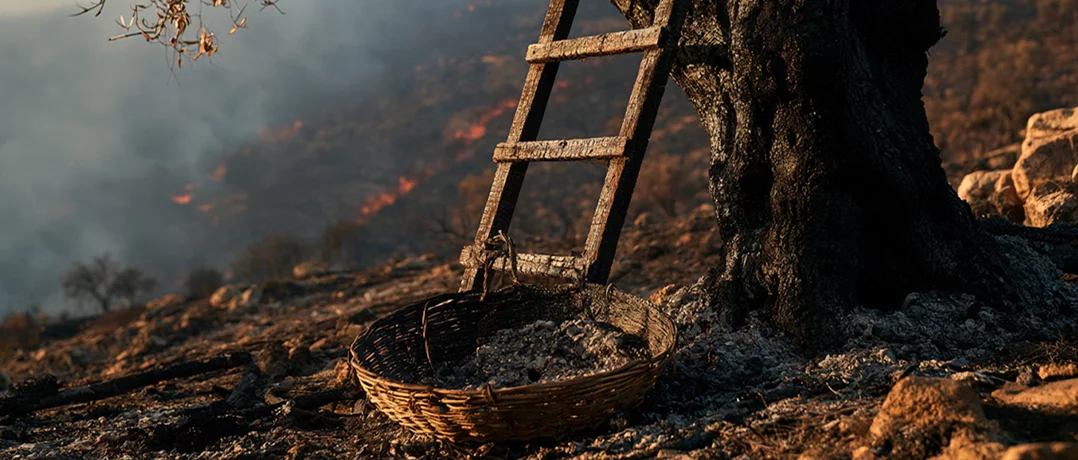
The story of Lebanon’s olive groves can now be told through two striking images: a field that disappeared and another that burned for more than a day.
In Zawtar Sharqieh, satellite images showed that an entire olive grove had been cleared, raising suspicions that the Israeli army had removed around 600 century-old olive trees. Days later, fire spread through Yaroun for more than 36 hours, consuming around 120 hectares (or 1,200 dunams), of orchards and olive groves. Residents could see the flames spreading across their land, but they could not reach the occupied village to extinguish them.
These were not isolated incidents. They were part of a much larger pattern of destruction that unfolded across southern Lebanon during the war.
Olives are not a marginal crop in Lebanon. Before the war, olive trees covered about 590 square kilometres, representing 9 percent of the country’s agricultural land.
The south was at the heart of this sector. Nabatieh produced around 21 percent of Lebanese olive oil, while South Lebanon produced another 15 percent. Together, the two governorates accounted for more than one-third of national olive-oil production.They were also the two agricultural regions most exposed to Israeli attacks.
This meant that damage to southern olive groves did not affect only individual farmers or border villages. It also struck a major part of Lebanon’s national agricultural production.
The first major figures appeared only weeks after the conflict began.
By November 16, 2023, the Lebanese Ministry of Agriculture had recorded 351 fires in 53 villages across the South and Nabatieh governorates, caused by Israeli bombardments, destroying more than 47,000 olive trees. Yet these figures covered only the opening weeks of the conflict, before the major escalation between September and November 2024, the Israeli ground invasion and the destruction that continued after the ceasefire.
The loss of 47,000 trees was therefore not the final toll. It was an early warning of what was still to come.
Fire became one of the main causes of agricultural destruction.
By July 2024, Lebanon’s National Council for Scientific Research had recorded 175 Israeli attacks involving white phosphorus, with fires affecting more than 600 hectares of farmland.
Amnesty International documented Israeli white-phosphorus attacks in southern Lebanon in October 2023. Human Rights Watch later said it had verified the use of white phosphorus in at least 17 municipalities. Meanwhile, the Israeli military had told Reuters that the main smoke shells it used did not contain white phosphorus.
The ammunition used in these attacks had serious consequences on the ground, leaving fields burned, soil damaged and olive trees that had taken decades to grow destroyed within hours.
National figures can sometimes feel distant. The village of Jibbin shows what those numbers meant for one community.
A UNDP assessment based on discussions held with local representatives in September 2024 found that repeated Israeli attacks, including phosphorus bombardment, artillery shelling and airstrikes, caused fires that burned more than 1,200 dunams of land and approximately 10,000 olive trees. Jibbin lost around 60 percent of its olive groves, while about 90 percent of local farmers were directly affected. Many also lost two olive-harvest seasons.
For these farmers, the destruction was not only about trees. It meant the disappearance of family income, stored olive oil, future harvests and land passed down through generations.
By the end of the 2024 war, UNDP estimated that 134 hectares of olive groves had been lost directly to fire and bombardment.
However, the larger economic blow came from the land that farmers could no longer reach. Around 4,800 hectares of olive orchards in border villages went unharvested during the 2023 and 2024 seasons. A further 14,400 hectares south of the Litani River were harvested late after the ceasefire.
These disruptions contributed to a 60 percent fall in olive production. The estimated loss reached 26,000 tons of production, while olive-oil prices increased by around 60 percent compared with 2022. The war also destroyed 16 olive mills, cutting off another essential part of the production process.
An olive harvest depends on timing. When farmers are displaced, roads are blocked or fields become too dangerous to enter, even trees that remain standing can produce a harvest that is effectively lost.
The destruction of olive groves formed part of a much larger agricultural crisis.
The Food and Agriculture Organization (FAO), Lebanon’s Ministry of Agriculture and the National Council for Scientific Research calculated $118 million in physical damage and $586 million in production losses between October 2023 and November 2024.
Together, the losses reached $704 million. This total included damage to crops, livestock, forests, fisheries and agricultural infrastructure. Yet olives were among the most seriously affected crops because a mature olive tree cannot simply be replaced during the next planting season.
Later estimates suggested that the number of affected olive trees may be far higher than the early official figures.
In October 2025, the head of Lebanon’s farmers’ syndicate told Al Jazeera that about 450,000 olive trees had been looted, bulldozed, burned or uprooted. He also said some mature trees had reportedly been transported across the border.
However, the figure has not been confirmed through a completed national survey. Many agricultural plots near the Blue Line also remained inaccessible, making it difficult for officials and farmers to inspect the land fully.
The destruction did not end with the major fighting of 2024.
By May 2026, the Agriculture Ministry reported that 56,264 hectares of agricultural land had been affected by ongoing attacks. This included 18,559 hectares that had suffered direct damage.
Around 6,600 hectares of olive groves were affected, while 64 southern towns reported damage to farmland, irrigation networks or agricultural facilities.
These figures show that southern agriculture was not facing only the consequences of a past war. Farmers continued to deal with new attacks, restricted access, damaged infrastructure and land that could no longer be cultivated normally.
The war on Lebanon’s olives cannot be measured through one statistic alone.
It is 47,000 trees lost during the opening weeks of the conflict. It is 10,000 trees burned in one village. It is 26,000 tons of missing production, 16 destroyed olive mills, 6,600 affected hectares by 2026 and an estimated 450,000 trees damaged, uprooted, burned or looted in different ways.
But behind every number is a much longer timeline.
An olive tree may take years before it begins producing properly. A mature grove can take decades to replace. Many of the trees destroyed during the war were older than the farmers who cared for them and, in some cases, older than the modern villages surrounding them.
Some damage may eventually be repaired, but an old olive grove cannot simply be rebuilt. Once century-old trees are gone, the harvests, livelihoods and family history tied to them are lost for generations.

Junior research writer focusing on politics, public policy and international affairs.
