



European leaders warn that war is no longer unthinkable, as Russian threats and uncertain US guarantees reshape Europe’s security planning.
Is Europe preparing for war?

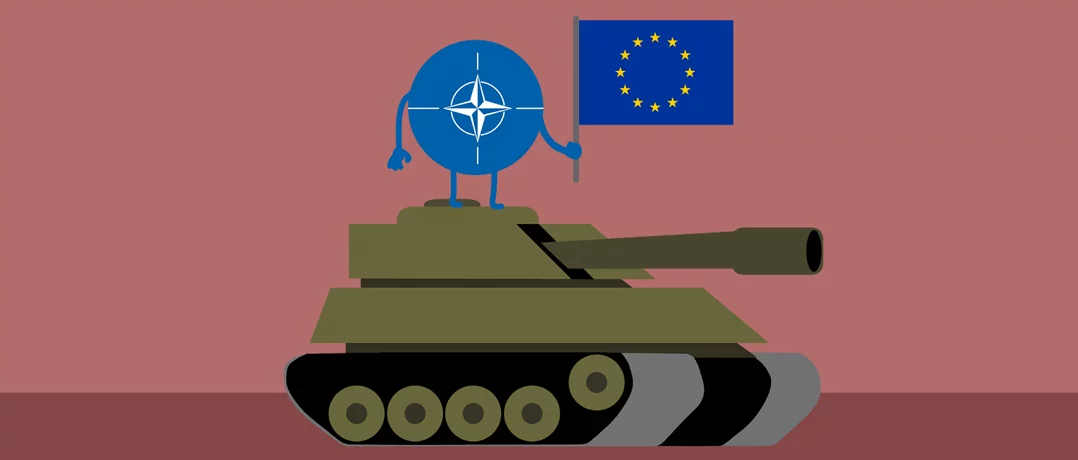
For the first time since the end of the Cold War (1945-1991), European governments are openly preparing their populations for the possibility of large-scale conflict. What was once considered unthinkable has re-entered mainstream political discourse: potential war on the European continent.
From emergency preparedness campaigns to stark warnings by military leaders, the message is increasingly clear: Europe can no longer assume peace as a permanent condition. This shift is driven by a convergence of factors, including Russia’s aggressive posture, the normalization of hybrid warfare and a growing realization that US security guarantees may no longer be unconditional.
Western leaders sound the alarm
Warnings from Europe’s political and military leadership have grown more explicit in recent months.
NATO Secretary General Mark Rutte has repeatedly cautioned that Europe is already “in harm’s way” and could face direct military confrontation with Russia within the next 3 to 5 years. Intelligence assessments in Germany and the Baltic states echo this view, suggesting Moscow is actively preparing for scenarios beyond Ukraine.
Senior military figures have also begun addressing the public directly. France’s armed forces chief, General Fabien Mandon, stated that Europeans must accept living in a “risky world” and prepare for the possibility of significant sacrifice. Such language, largely absent from European discourse for decades (as economic and development projects took precedence), reflects a deliberate effort to recalibrate public expectations and normalize the idea of national resilience under threat.
Such warnings are particularly alarming to the European Union (EU), which was established not only to create a single market and promote democracy and economic development, but most importantly to prevent the outbreak of war in the continent (similar to the previous WWI and WWII which devastated Europe’s infrastructure, economy, military and political might).
The Russian threat
Russia’s actions have reinforced these concerns. While Moscow denies plans for direct conflict with NATO, its rhetoric and military behavior suggest a deliberate strategy of intimidation and ambiguity. President Vladimir Putin has declared that Russia is “ready for war” if Europe seeks confrontation, while Russian officials increasingly frame NATO as an existential enemy. Just recently, Putin warned that “if Europe suddenly wants to start a war with us and starts it,” then it would end so swiftly for the continent that Russia would have no one left to negotiate with.
Beyond rhetoric, Europe has experienced a steady rise in what officials describe as hybrid warfare. These include cyberattacks on critical infrastructure, GPS jamming in the Baltic region, suspected sabotage operations, disinformation campaigns and repeated drone and airspace incursions. Although difficult to attribute conclusively, the cumulative effect has been to create an atmosphere of permanent instability below the threshold of open war.
The concern is not only a sudden invasion, but a gradual erosion of resilience that could leave Europe vulnerable in a future crisis.
Preparing for a new reality
European governments have begun translating strategic warnings into civil preparedness measures. The Netherlands’ distribution of a booklet instructing households how to survive without electricity, water or communications for 72 hours is emblematic of this shift. Similar guidance has been issued in Sweden and Finland, where the concept of “total defense” integrates civilians into national security planning.
Reintroducing or expanding military service has become another visible trend. Several countries have reinstated conscription or launched voluntary training programs to bolster reserves. These measures signal a recognition that modern deterrence requires not only advanced weapons but also societal readiness.
At the same time, officials face a delicate balance. Preparing the public without inducing panic or political backlash remains a central challenge, particularly in countries where trust in institutions is weaker (namely in Eastern Europe).
Europe’s military capabilities: Progress and shortfalls
Regarding Europe’s ability to defend itself, this aspiring objective remains uneven.
Defense spending has risen sharply since Russia’s invasion of Ukraine, with most NATO members now meeting the 2% of GDP target. However, experts warn that financial commitments alone do not translate quickly into battlefield readiness.
Decades of underinvestment have left European militaries short on ammunition stockpiles, air defense systems and deployable forces. Analysts note that current NATO defense plans often rely on capabilities that do not yet exist at scale. While frontline states such as Poland and the Baltic countries are moving rapidly (given their close extremity to the Russian threat), larger Western European powers face slower mobilization timelines.
Crucially, Europe remains heavily dependent on US support; particularly in intelligence, logistics and nuclear deterrence. As Washington signals a desire to shift strategic focus elsewhere, the gap between European ambitions and capabilities has become increasingly visible.
In conclusion, Europe is confronting a gloomy reality: the peace which the continent enjoyed for the past 8 decades is over. Russia’s actions, combined with uncertainty over American commitments, have forced Western leaders to express explicitly about the risks ahead. While significant steps are being taken to strengthen defenses and prepare societies, time remains a critical constraint. Whether Europe can translate awareness into credible deterrence will shape not only its security, but the future stability of the continent itself.
-
-

-
The Beiruter
-
