


For its second edition, the Italian Film Festival in Lebanon leans into continuity, contemporary cinema, and cultural exchange, turning Metropolis Art Cinema into a bridge between Rome and Beirut.
Italian cinema finds its rhythm in Beirut

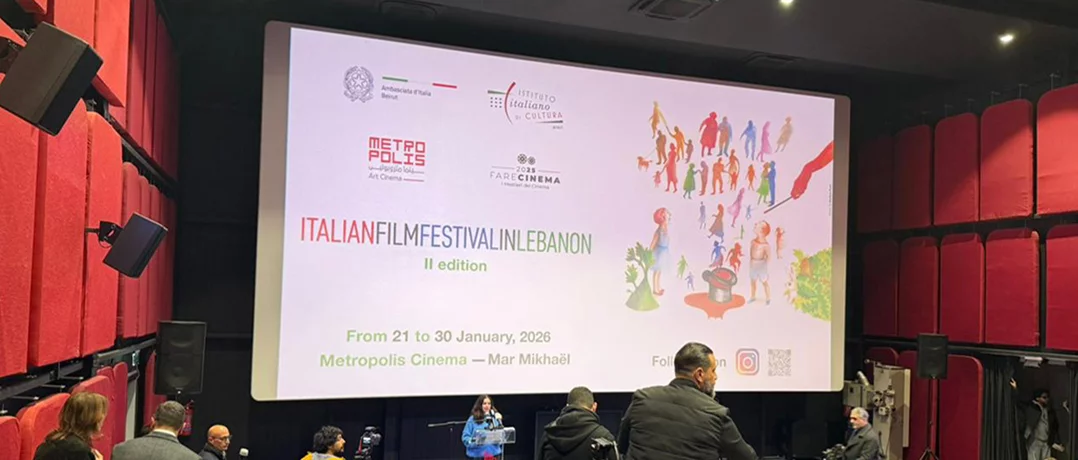
“The first edition revealed a strong and attentive response from Lebanese audiences when Italian cinema is presented within a clear and autonomous framework,” says Dr. Angelo Gioe, director of the Italian Cultural Institute. That answer is the one that brings the Italian Film Festival back to Beirut this January — not flashier, not larger; rather more deeply rooted in the ground.
The festival comes back again with its second edition from Wednesday, Jan. 21, to Jan. 30, and Metropolis Art Cinema will be hosting all the screenings. The new edition has been officially declared by Gioe, and it reflects last year's energy as a gradual surpassing the former, seeking to become a regular part of the city’s cultural events instead of a one-off cultural event in the calendar year.
Where the first edition tested the waters, this one leans into continuity, strengthening the festival’s identity and deepening its relationship with local audiences and cultural partners, one screening at a time.
A cinema of many voices
This year’s program doesn’t ask audiences to follow a single theme. It asks them to move. Across 10 evenings at Metropolis Art Cinema, the festival travels through classrooms, streets, families, borders and inner lives, offering a snapshot of contemporary Italian cinema in motion. “The selection was curated with an emphasis on diversity of voices and cinematic forms rather than on a single thematic focus,” Gioe explains, and that openness is precisely what gives the lineup its energy.
“Primavera” by Damiano Michieletto, a visually charged work that sets the tone for the whole program with its emotionality, opens the festival. From there, the films take off in a variety of unexpected directions. Laura Samani’s “Un anno di scuola” (A Year of School) puts the classroom up to its limit, presenting adolescence as a very delicate negotiation process among authority, identity, and becoming.
“A Testa o Croce” (Heads or Tails) by Alessio Rigo de Righi and Matteo Zoppis, which is the western tipping over, is scheduled for later in the week and will be mixing folklore, irony, and rebellion into a playful yet political genre exercise. “Gioia mia” (Sweetheart), the most heartfelt of all films, is the one to take intimacy to the top, a gentle coming-of-age movie which is still, according to its director, a lover's vulnerability, and innocence without sentimentality.
Another director, Riccardo Milani, takes a different approach by zooming out in his “La vita va così” (Life Is Life) and through the application of kindness accompanied by astute social commentary, he sees the struggle for existence in a much broader scale.
Together, all of the films reflect what Gioe describes as cinema that is “deeply rooted in social and historical contexts,” yet driven by personal vision. Seen back-to-back, they form a mosaic rather than a manifesto — one that invites Lebanese audiences to encounter Italy not as an idea; rather as a living, questioning presence.
Culture as continuity, not spectacle
For Gioe, the screenings are only one part of the festival’s architecture. “The Italian Film Festival functions as a tool of cultural diplomacy by making contemporary Italy visible through cinema,” he says, visibility on its own, is not the end goal. “This visibility becomes the basis for longer-term exchange.”
That exchange is designed to unfold beyond January. Festival activities in the future will involve workshops and professional encounters with Italian practitioners of different areas, amongst which are screenwriting and other key sectors of filmmaking. Instead of revealing a definite schedule for the whole project ahead of time, the emphasis is on establishing a long-standing, significant partnership with Lebanon's artistic community, which will make the project evolve naturally and be in tune with local conditions.
Even the choice of Metropolis Art Cinema as the festival’s home reinforces this long view. “Metropolis embodies a precise editorial identity and a long-standing commitment to independent and auteur cinema,” Gioe says. Not just a place to watch movies, but a cultural hub where films are put into context, discussed, and digested gradually. This positioning is deliberate: the festival chooses to offer conversations instead of grand displays, and to provide depth rather than enormous measures.
Organizing an international cultural event in Lebanon today, Gioe acknowledges, comes with weight. “Sustaining an international cultural event in today’s Lebanon requires responsibility, adaptability and a clear sense of priorities,” he says. This implies a tight collaboration with local stakeholders, being responsive to the changes that the nation goes through and setting up programs that are down-to-earth instead of mere gestures. In such a situation, the very continuity turns out to be a form of care, dedication to keeping up when everything else seems to be uncertain.
As for what he hopes audiences will take away from this second edition, Gioe resists tidy conclusions. “Rather than a single message, we hope audiences leave with questions, impressions and connections that extend beyond the screenings themselves,” he says. If the festival sparks curiosity and encourages sustained engagement with Italian cinema over time, then it has done its job.
For ten days in January, Metropolis Art Cinema becomes that meeting point — where Italian stories unfold on a Beirut screen, and where continuity itself feels like a quiet, deliberate statement.
-
-
-
Rayanne TawilCultural writer
-
