



One of Hamra's most famous hotel has shut its doors after 82 years. Le Commodore was not only a place for rest; it was a remarkable building, a shelter during war, and a chronicler of the many transformations of Beirut.
Le Commodore checks out

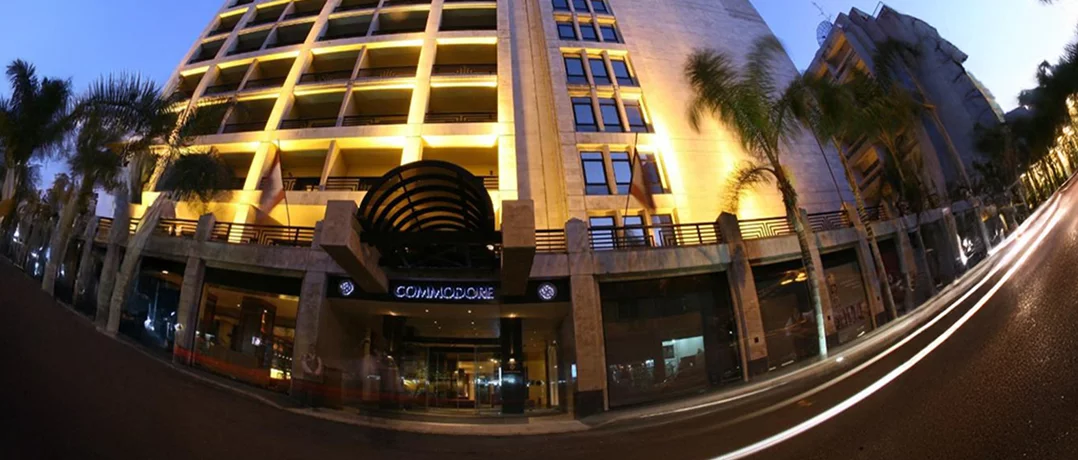
On Jan. 10, 2026, Le Commodore Hotel closed its doors for good. There was no grand farewell, no final curtain call, just a quiet ending to a place that had carried Beirut’s pulse for more than eight decades. For generations of locals, journalists, artists and passersby, the Commodore was never just a hotel. It was a shelter, a meeting point, a landmark you oriented yourself around in Hamra. Its closure felt less like a business decision and more like a chapter being torn out of the city’s memory.
Built in 1943, at a time when Hamra was still more promise than neighborhood, the Commodore once stood almost alone. “Back then, it was on a street leading to Sadat at the end, It impressed by clarity, but surrounded with modest building style and few were modernist,” architect and professor Omar Harb explained. “You had the seafront, the main Hamra street, the universities and suddenly this very modern building planted in between trees.” It wasn’t trying to impress by scale or extravagance.
Harb, who teaches architecture at several universities in Lebanon and research modern buildings in Lebanon, described the original Commodore as a textbook example of the modern movement. Horizontal windows, linear balconies, an elevated structure, a clear separation between façade and structure, “all the five points of modern architecture were there,” he said, referencing Swiss-French architect Le Corbusier’s teachings. White, linear, open to the sun, the building wrapped itself gently around a garden and a kidney-shaped pool that would later become iconic. In 1943 Beirut, this was avant-garde.
A safe side in a city at war
If architecture gave the Commodore its form, history gave it its soul. When the Civil War erupted in 1975, the hotel found itself on what was known as the “safe side.” Far from the clashes near the seafront and downtown hotels, it became a natural refuge. “All the journalists came and stayed there,” Harb recalled. Inside its lobby, stories of war were written while outside, Beirut fractured.
The hotel itself was not spared from the chaos. It was evicted, looted, passed between hands like so many properties of that era. Yet it survived; bruised, altered, but standing. Its lobby walls filled with photographs of reporters and moments frozen in time, turning the interior into an unofficial archive of a country at war, waiting, as Harb put it, for the war to stop and the revolution to start.
Hamra grew around a pool
Over the years, the Commodore didn’t just adapt to Hamra; Hamra grew around it. The pool and garden became a visual anchor. “People used to fight to build around it,” Harb said. From its balconies, guests once looked out over open land, then slowly over a neighborhood rising around them. Restaurants came and went, but some became legendary. Benihana, the Japanese restaurant that later moved to a villa in Monot, helped cement the Commodore as a social destination, not just a place to stay the night.
Not all changes were kind. A later L-shaped extension disrupted the clarity of the original design. “It didn’t feel modern at all,” Harb admitted. To him, the newer addition never spoke the language of Hamra, nor of the original building. “If you look at old photos,” he said, “the hotel actually felt more modern than it did at the end.”
Architecture as memory
What made the Commodore’s closure particularly painful was how much memory it held, and how fragile that memory remained. The name of the original architect was never confirmed, lost along with so many archives burned during the war. “This is the story of modern buildings in Lebanon,” Harb said.
It’s like buying a Picasso without documentation. Whoever hears the story first owns the information.
For Harb, architecture was never neutral. It absorbed behavior, embarrassment, openness and generosity. Balconies, transparency, modesty, these were not aesthetic choices alone, but social ones. “A building has to be smooth with its neighborhood,” he explained. “If it feels too sharp, too closed, people reject it.” The original Commodore invited people in. It did not hide behind walls.
By the time the hotel closed, its future remained uncertain. Preservation, erasure, reinvention all possibilities lingered. Harb believed the answer lay somewhere in between. “We can’t forget the memory, and we can’t turn our backs on evolution,” he said. “We need to merge the two.”
For him, that meant rejecting total demolition but also refusing superficial nostalgia. Adaptive reuse, openness to the public, respect for the original vision without freezing it in time.
“If it’s a hotel, it should call people inside,” he added. “An L-shape closes a building. An open plan invites the city.”
On Jan. 10, Le Commodore stopped receiving guests. But long after the keys were handed back and the lobby lights went out, the building continued to live in Beirut’s collective imagination, as a witness, a refuge and a reminder of a time when architecture dared to be generous. In a city that is constantly rebuilding, Le Commodore left behind a difficult question: what do we do with places that hold our stories when they no longer fit the economy of the present?
-
-

-
Rayanne TawilCultural writer
-
