



Lebanese kaak, a taste of home across regions
Lebanese kaak, a taste of home across regions

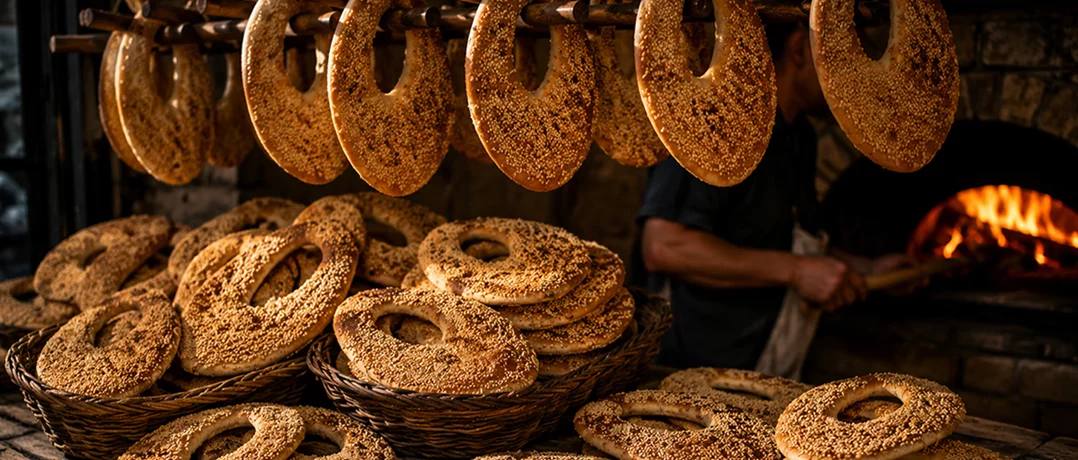
Lebanese kaak is a name that covers not one recipe but an entire family of baked goods stretching across regions, religions, and centuries. To understand how one word holds so many different breads, we spoke with veteran baker Samira Fakhoury, who has spent over thirty years working ovens across Lebanon and now teaches traditional baking techniques to a new generation.
One name, many breads
"People assume kaak is a single thing," Fakhoury said, "but really, the word just means something closer to 'ring-shaped baked good.' Once you understand that, the whole map opens up." According to her, the most internationally recognized version is kaak bel simsim, the sesame-crusted street bread sold from carts across Beirut, shaped into a large, hollow ring and traditionally hung along a pole for vendors to carry through crowded streets. "It's yeasted, it's chewy, and it has that beautiful crunch from being rolled in sesame before baking. In Beirut, people eat it plain, dipped in za'atar mixed with oil, or split open and stuffed with cheese."
She was careful to distinguish this savory street bread from Lebanon's sweeter cousin. "What surprises visitors is that in Lebanon, kaak often leans dessert, not savory. The dough is enriched, shaped into rings or love-knots, and after baking it gets brushed with a milk-and-sugar glaze and left to dry. That's kaak bi halib, 'kaak with milk.' Some bakers add orange blossom water to the dough, which gives it that unmistakable Lebanese perfume."
Tripoli's flatbread and the North's communal ovens
Heading north, Fakhoury described an entirely different silhouette. "In Tripoli, they make what's called kaleeta, a flat, round kaak, wider and thinner than the ring you'd see in Beirut, studded generously with sesame." She explained that this version is deeply tied to the city's tradition of communal neighborhood ovens, where families would bring shaped dough to be baked together rather than in individual home kitchens. "You'd walk through certain streets in Tripoli and just see rows of these flat sesame loaves cooling. It's a very communal bread, tied to a specific baking culture, not just a recipe."
She also mentioned a related but distinct everyday version called kaak asrieh, sometimes referred to as "afternoon kaak." "It's less formal, more of an everyday snack bread. Every region has its own slight variation on shape and crumb, and honestly, most bakers guard their exact ratios like family secrets."
South Lebanon's molded, spiced kaak el abbass
The most distinct version Fakhoury described was not shaped by hand at all. "In the South, particularly around Ashura, we make Kaak el Abbass," she said. "It's completely different from the yeasted breads, this is a semolina-based cookie, pressed into carved wooden or metal molds that stamp a pattern onto the dough." Unlike the street kaak, this version leans on anise, cinnamon, clove, and nutmeg rather than sesame alone. "It's lightly sweet, crumbly rather than chewy, and it's not just food. It's traditionally made to honor Al-Abbas, and sharing it is considered a form of charity during Muharram."
She noted that similar semolina, anise-scented cookies appear elsewhere in the Levant during other holidays, "but what makes Kaak el Abbass specific is the occasion and the intention behind baking it. The same basic technique, mold, semolina, spice, gets repurposed with a completely different meaning depending on where and why you're making it."
What unites all these versions despite their differences, is technique. "Whether it's yeasted street kaak or molded Ashura cookies, the discipline is the same, you need the right flour, the right resting time, and patience. Kaak dough doesn't like to be rushed. I always tell students, a bread that's baked in a hurry tastes like it was baked in a hurry."
She added that regional identity in Lebanese baking is rarely about competition. "Nobody argues that Tripoli's kaleeta is 'better' than Beirut's ring kaak. They're not competing, they're just answers to the same question, shaped by different cities, different ovens, different hands."
What emerges from Fakhoury's tour is less a map, sesame rings sold from carts in Beirut, flat communal loaves cooling in Tripoli's shared ovens, molded spiced cookies marking grief and remembrance in the South. "Kaak survives because it adapts," she said. "It became whatever each region needed it to be, breakfast, street food, dessert, ritual. That's rare for a bread this old to still be this alive."
-
-

-
The Beiruter
-
