



At Les Jardins du Mzaar's Summer Festival, 19 Lebanese artists transformed retired ski chairlifts into immersive installations, turning the mountain resort into an open-air gallery where visitors could sit, interact and experience art.
Old chairlifts get a second life at Mzaar Kfardebian
Old chairlifts get a second life at Mzaar Kfardebian
By Rayanne Tawil | August 09, 2026

Reading time: 5 miin
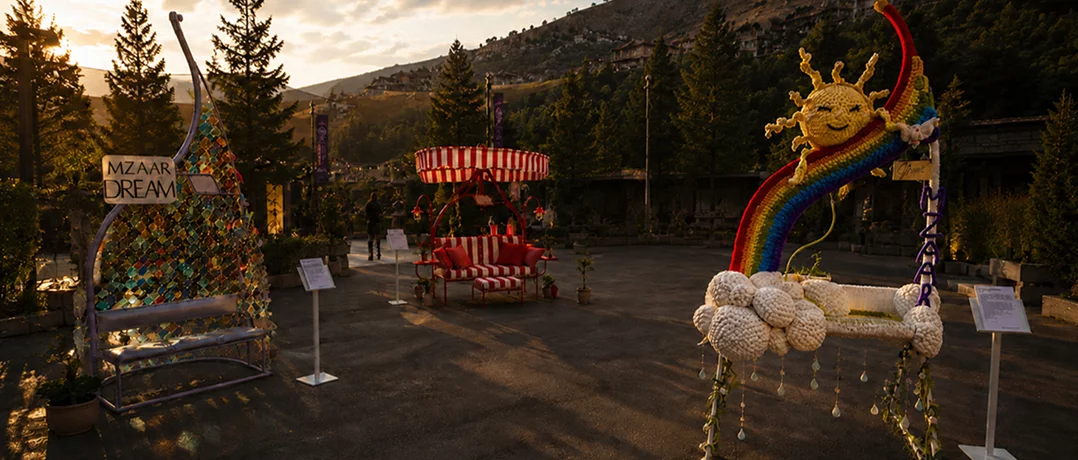
A ski chairlift is usually associated with snowy slopes, thick jackets and a ride toward the mountain peaks. At Les Jardins du Mzaar, it has found an entirely different purpose.
For this year's Mzaar Summer Festival, running from July 30 until Aug. 23, retired chairlifts were pulled from storage and handed over to Lebanese artists, architects and designers. Rusted metal frames once destined for a warehouse returned as colorful installations scattered across the festival grounds, inviting visitors to stop, sit and look a little closer.
Children climbed onto rainbow-covered seats, friends lined up for photos, families tested the comfort of each design while music drifted across the mountain. Around them, artisan kiosks, food stalls and beverage stands kept the festival buzzing late into the evening.
Giving old chairlifts new life
The exhibition began with a question from curator Gui Asmar: what happens to a chairlift once its skiing days are over?
“During winter, the chairlift is the iconic element of Mzaar,” Asmar said.
We had old stock sitting in storage, so I wanted to give them a new life.
He launched an open call expecting around a dozen submissions. Nineteen artists eventually joined the project, each approaching the same object from an entirely different perspective.
“We wanted to go beyond craftsmanship,” Asmar said.
People already come here to eat, shop and listen to music. Art brings a different audience. I was surprised by how many artists wanted to take part.
The opening evening reflected that shift. Alongside the exhibition, the Lebanese National Philharmonic Orchestra, conducted by Lubnan Baalbaki, performed with soprano Ekaterina Somicheva and the Notre Dame University Choir, filling the mountains with classical music as visitors wandered between the installations.
Every chair tells a different story
No two chairlifts looked alike. One became a floating dream wrapped in shimmering reflective discs. Another resembled a vintage Volkswagen camper. A third transformed into an outdoor lounge chair complete with a striped canopy, shelves for garden accessories and integrated lighting.
Interior designer Alexandra Warde imagined what would happen if a ski lift never returned to the slopes. “I asked myself how I could use a winter object during summer,” she said. “I turned it into a functional garden bench with shelves, lighting and a sunshade.”
Her “Alpina LoveChair” quickly became one of the exhibition's most photographed installations. “I've noticed people are positively surprised,” Warde said. “They immediately want to come closer, sit on it and take pictures.”
For Warde, the project also encourages designers to think differently about public space.
I think every designer should integrate more public living into their work.
Just a few steps away, Sarah Saroufim of Lilly the Van reimagined her chairlift as “The Ride,” inspired by her beloved 1977 Volkswagen T2 camper. “As soon as you step inside Lilly, the adventure has already begun,” she said. “The conversations and unexpected stops often become more meaningful than the destination.”
She deliberately kept the chairlift's mechanism working so visitors could experience it instead of observing it. “I hope ‘The Ride’ reminds people that life isn't meant to be rushed,” Saroufim said. "The destination will always be there. The magic happens along the ride.”
Designing comfort through resilience
Among the installations, one invited visitors to sink into layers of soft white fabric.
Created by Caline Morcos Interiors and Atelier S/Z by Sibylle Tamer, “Beneath the Velvet” wrapped the industrial chairlift inside a cocoon inspired by healing.
“[Sibylle Tamer and I] thought about our wounds as Lebanese people,” interior architect Caline Morcos said.
We wanted something protective. The fur creates that cocoon feeling, while the golden scar reminds us that painful experiences can become something beautiful.
Tamer described the installation as a reminder that hope survives difficult moments. “It shows that even painful experiences can become hope,” she said. “We're always trying to heal our scars and we're succeeding.”
Visitors didn't hesitate to test the piece themselves, settling into the oversized seat as if it belonged inside a living room rather than on a ski slope.
Holding on to the dream
Artist Elise Salameh chose emotion over nostalgia.
Her installation, “Dream,” shimmered under the evening light with reflective elements inspired by snow, sunlight and mountain skies. “I wanted to recreate the magic of riding a chairlift in the Lebanese mountains,” she said. “Through color, light and movement, I transformed a heavy industrial object into something dreamlike.”
The changing mountain landscape completed the artwork throughout the day.
The natural light, the wind and the surrounding landscape all become part of the installation.
Watching visitors interact with the piece became part of the experience itself. “I hope they pause for a moment,” she said. “If I've made people associate a chairlift with beauty and emotion, then I've achieved what I wanted.”
The final chairlift in the row rarely stayed empty for long. Someone was always climbing aboard, testing another artist's imagination before moving on to the next one. Watching visitors queue to photograph the installations convinced Asmar the concept had a future beyond this summer.
“I definitely see this becoming an annual event,” he said. “This year was about honoring the artists. Next year, we'll go bigger. I want Mzaar to become a place where people come for art as much as they come for the festival.”
-
-

-
Rayanne TawilCultural writer
-
