



Two aging radio repairmen preserve a disappearing Lebanese craft, and the memories embedded in the machines they keep alive.
Radio repair… an act of memory

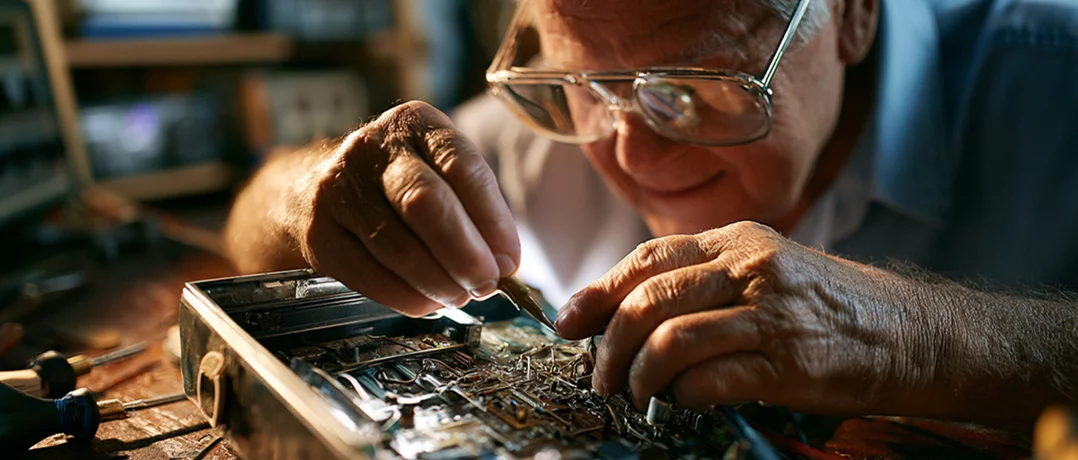
There was a time when a household's first voice each morning belonged not to a person, but to a radio. Before screens colonized every room, families across Lebanon gathered around wooden cabinets to receive the news, the songs, and the sermons that shaped their days. When those radios fell silent, they were carried, almost reverently, to men whose hands understood circuitry as a physician understands a pulse. Today that vocation fades into Lebanon's long inventory of disappearing trades. Yet in Sour and Ehden, two repairmen still open their doors, and their memories, to anyone willing to listen.
A trade learned by listening
In the coastal city of Sour, seventy-five-year-old Mousa Haddad has spent six decades coaxing dead radios back to life. He came to the craft through an adolescent's stubborn curiosity. “I was always curious about how things worked,” he recalled. “If a radio stopped working, instead of throwing it away, I wanted to open it and understand why.”
For Haddad, diagnosis begins not with a screwdriver but with the ear. “First, you listen,” he said. “That sounds strange, but listening tells you a lot.” Only then does the casing come off, revealing wires, resistors, capacitors, and coils, each a possible culprit. “You can't just start changing everything. You have to understand where the problem is.”
What sustained Haddad through the decades was never simply mechanical. Many of the sets that arrived carried inherited weight. “This was my father's radio,” customers would tell him, or, “My mother used to listen to this every morning.” In such moments, he said, “you understand that you're repairing a memory.”
That understanding has not translated into continuity. “The knowledge disappears with the person,” Haddad reflected. “You can buy a new radio. But you cannot buy fifty years of experience.” Yet when a rare visitor arrives with an old set, something in him stirs, “Sometimes I think my hands remember before my head does.”
Today, if something stops working, people say, ‘It's finished. Buy another one,’” Haddad said. “We used to say, ‘Let's see if we can save it.” “The most important thing is patience”, Haddad said simply. “Repairing something teaches you not to throw it away immediately. You look at it, you understand it, you try again.”
Evolving with every new machine
Further north, in the mountain town of Ehden, sixty-eight-year-old Nabil Daher describes a career defined not by one technology but by an unbroken succession of them. “At the beginning it was mainly radios,” he said. “Then cassette players became popular. Then video cassette players. Then televisions. Later came CD players, DVD players, music systems.” Each arrival demanded fresh study, “Every time a new machine arrived, I had to learn how it worked.”
There was no manual for this reinvention. “You learn one machine, then another one comes, and you open it,” Daher explained. “You study it. You ask someone who knows more than you.” Of all the machines he encountered, DVD players tested him most, “They look simple from the outside, but inside there are many things that can go wrong. Before, you could spend hours repairing something. Today, sometimes the technician just changes the board. A repairman should know why something stopped working.”
Like his counterpart in Sour, Daher discovered he was often repairing something beyond the object itself. He recalls a man who brought in a failing cassette player, “He had recordings of his mother singing. He was not interested in buying a new player. He wanted to hear that tape.” As Daher put it, “maybe the machine is worth twenty dollars, but the cassette inside is priceless.” Daher told The Beiruter, “most things are not as dead as they look.”
What remains when the signal fades
Neither man speaks of his profession with bitterness. Both describe its decline as an inevitable current of history, the same current that once carried radios into every Lebanese home. “Maybe in twenty years there will be something else,” Haddad mused, “and they will say, ‘Do you remember when people used phones?’”
What troubles them is not obsolescence itself, but forgetting, the chance that a craft might vanish without anyone remembering how it was practiced, or why it mattered. In their workshops, both men an insistence that broken things deserve a second listening before they are pronounced finished.
-
-

-
Jenna GeageaReporter/Writer
-
