



Social media can be a lifeline or a weapon, showing how the same platforms can mobilize compassion to save lives while amplifying harm, exploitation and despair.
Social media saves and destroys

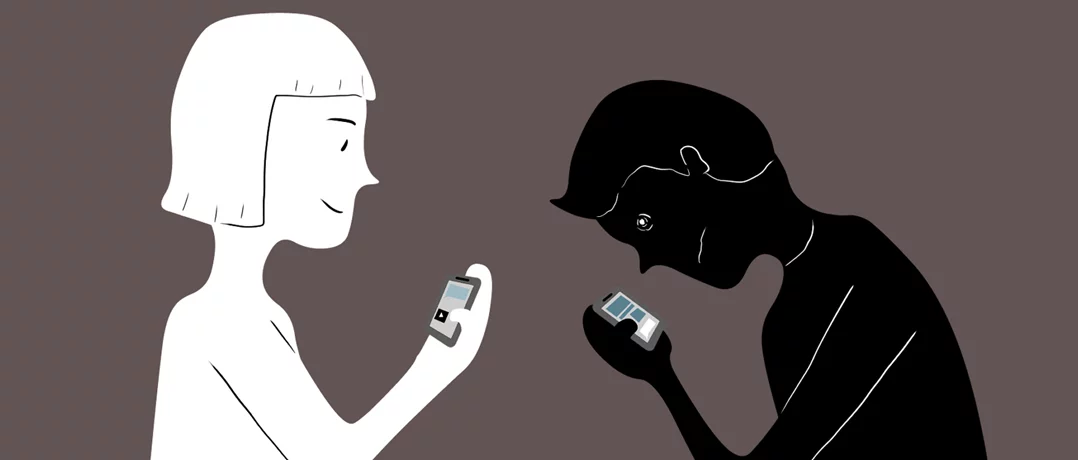
Illustration by Karim Dagher
Social media has no morality of its own. It is a current that carries whatever is put into it , and depending on who is doing the carrying, that current has pulled dying strangers back from the edge and pushed grieving teenagers over it. Both stories are true at once, and both deserve to be told with facts, not slogans.
When it saves
The clearest proof of social media's power to heal is money moving toward sickness instead of away from it. GoFundMe, the largest crowdfunding platform in the world, reports that medical campaigns make up roughly a third of everything raised on the site, more than $650 million a year across over 250,000 campaigns. A University of Washington study of 437,596 U.S. medical GoFundMe campaigns found they collectively pulled in more than $2 billion between 2016 and 2020 from 21.7 million individual donations, almost all of it sourced through people sharing links on Facebook, Instagram, and WhatsApp rather than through any traditional charity structure.
Individual stories carry weight statistics can't. In 2015, 24-year-old newlywed Matthew Schreindorfer of Laval, Quebec, was diagnosed with an aggressive leukemia and told his only chance was an experimental trial costing $675,000, money neither he nor his insurance had. His wife posted his story to Facebook. It spread. In two months, strangers around the world had donated nearly $740,000. Schreindorfer got the treatment. Months later he announced he was in complete remission, crediting the "strangers" who "came together to give me a second chance at life."
The same dynamic scaled up to a global disease in 2014, when the ALS Ice Bucket Challenge turned a simple dare into $115 million for ALS research in a single summer. An independent RTI International audit found that money increased the ALS Association's annual research spending by 187 percent, funded the discovery of five new ALS-linked genes, expanded specialized ALS clinics from 100 to over 220, and helped fund the development of a new ALS drug treatment. None of it would exist without a hashtag.
When it destroys
The same mechanics that move money can move despair. The U.S. Surgeon General's 2023 advisory found that adolescents who spend more than three hours a day on social media, the average teenager spends three and a half, face double the risk of depression and anxiety symptoms, and 46 percent of 13-to-17-year-olds say the platforms make them feel worse about their bodies. Research published in JAMA found that young people who experience cyberbullying are more than four times as likely to report suicidal thoughts and attempts as those who don't.
Lebanon has felt this directly. In 2026, 15-year-old Mattias Charbel Habib died by suicide after what his family describes as prolonged conversations about death with ChatGPT, not social media in the traditional sense, but the same category of unsupervised digital companionship. His parents, Soha and Charbel Habib, are preparing a U.S. lawsuit against OpenAI and have launched the Mattias Habib Foundation to warn other parents about AI's psychological risks to minors. Separately, seven-year-old Mohammad Istanbuli of Tyre died of cardiac arrest after masked, sword-wielding teenagers filmed a prank video near his home for TikTok, a death with no bullying involved, only the platform's appetite for shock content colliding with a small child's heart.
The pattern repeats internationally. Seventeen-year-old Jordan DeMay of Michigan died by suicide in 2022, hours after Instagram scammers threatened to release explicit photos of him unless he paid them; two men were later sentenced to more than 17 years in federal prison. The National Center for Missing & Exploited Children has linked at least 36 teen boys' suicides to financial sextortion schemes run largely through Instagram.
And the same generosity that saves lives can be turned against the people it's meant to help. In Florida's Dixie County in 2026, parents Edward Downing and Stephanie Skeris allegedly told their community, and a GoFundMe page, that their son had cancer requiring surgery. Investigators found the money , raised in a bank account earmarked for his "treatment", had instead gone to retail purchases, gas, and restaurant meals. The boy, who was never actually diagnosed with cancer, was removed from the home and placed in protective care.
The verdict
Social media didn't decide to fund Matthew Schreindorfer's cure, and it didn't decide to become the last thing Mattias Habib and Jordan DeMay ever engaged with. People did, using the same tool. The platforms amplify whatever is fed into them, compassion, cruelty, generosity, fraud, faster and further than any medium before them. That amplification is the whole story. It is why one GoFundMe page can save a life in eight weeks, and why one cruel message or algorithm-fed feed can end one just as fast. The people using the technology are the actor and that is exactly why platform accountability and basic digital literacy matter more than ever.
-
-

-
Jenna GeageaReporter/Writer
-
