



Lebanon has banned the re-export of scrap shipments from Syria in a move aimed at curbing smuggling, money laundering, and the black economy.
Syrian scrap is banned in Lebanon

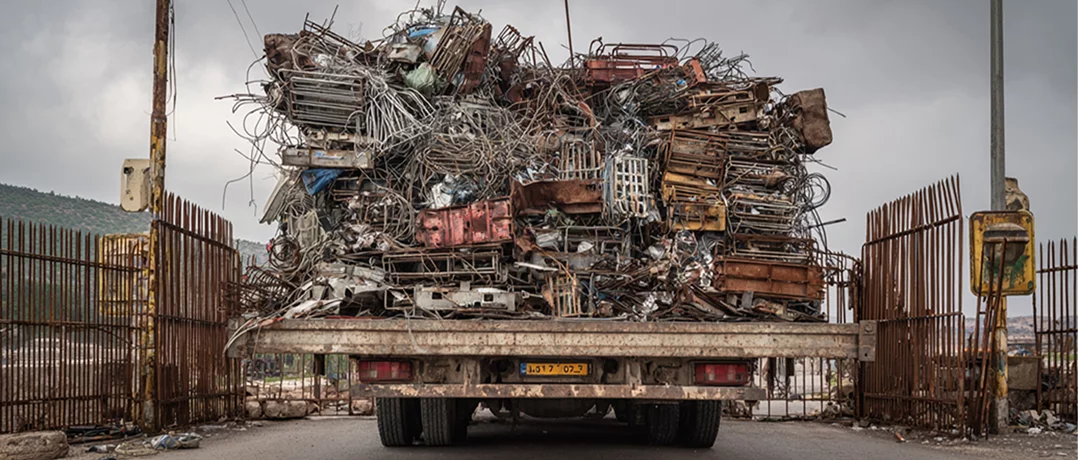
Source: Nida Al Watan
The Council of Ministers, at its most recent session and at the request of the Ministry of Finance, approved a ban on scrap shipments coming from Syria to Lebanon for the purpose of re-exporting them from Lebanese ports. Why was this decision issued, and what are its underlying reasons?
The trade in metal scrap constitutes a major component of a global iron and steel industry market valued at approximately $46 billion worldwide. This trade has been active in Lebanon and Syria, and between the two countries, since the outbreak of the Syrian crisis in 2011, because the collection of metal and iron scrap forms an indispensable part of revitalizing the steel industry, which is considered one of the most environmentally polluting industries in the world. This industry is responsible for about 11% of global carbon dioxide emissions. Since steel is a fully recyclable material, many countries have entered this field over recent decades, including Syria, which has been ravaged by destruction and whose areas have become filled with rubble, as well as Lebanon, where the Israeli war destroyed several regions, making the debris of that war an incentive for boosting the scrap trade.
However, the journey of Syrian scrap begins at factories in Adra and elsewhere in Syria and heads toward Lebanon via the Beirut-Damascus road, in trucks loaded for export. The scrap ultimately reaches Turkish steel plants, where it is mixed with similar materials from various sources.
Since 2020, Lebanese trucks have begun entering collection centers in Syria, loading scrap and transporting it to Lebanon after paying between $100 and $130 per ton. That ton is then resold in Lebanon and abroad for $300. Lebanese trucks most often went to load scrap from the al-Matalla collection center, with scrap and iron exiting Syria to Lebanon either through the Jdeidet Yabous crossing or via the Homs-al-Qusayr border gate, then reaching Lebanese ports and being shipped by vessels to Turkey.
The trucks entered either through official channels, licensed trucks passing through customs crossings between the two countries, with invoices/certificates of origin if intended for export or recycling in a corporate capacity, or through unofficial channels, namely smuggling via small vehicles or trucks carrying mixed loads, sometimes concealed among other goods or using alternative routes to bypass oversight.
According to certain documents found at one of the checkpoints on the Lebanese-Syrian border, the number of trucks passing monthly from Syria to Lebanon loaded with scrap is about 100 trucks. It should be noted that the price of scrap iron per kilogram, after entering the Lebanese side for trading and transport to Lebanon, doubled in Syria from 4 cents to about 10 cents. It is also worth noting that more than 2 million tons of iron scrap have left Lebanese ports bound for Turkey since 2013, according to United Nations Comtrade database statistics, most of it originating from Syria.
Export companies in Lebanon load containers or trucks and send scrap (particularly copper, aluminum, and iron) to neighboring countries or to factories in Turkey, Europe, and East Asia.
The black economy
Why has the Lebanese government now moved to ban the re-export of scrap coming from Syria?
There are several reasons, foremost among them combating the informal black economy that fuels money-laundering operations. The scrap trade, along with Captagon, was at the top of the business pyramid of Syria’s Fourth Division affiliated with the Assad regime, which built its economy on organized crime. Specific companies that are still operating today were responsible for and entrusted by the regime with this trade. It should be noted that the major scrap dealers in Syria prior to the fall of the regime are today on US and European sanctions lists, and their places of residence are unknown. Just as the Captagon trade was a source of income for the Syrian regime and a tool for financing Hezbollah, so too has the scrap trade continued after the fall of the regime.
Since the scrap trade is an informal one, it falls within the black economy in both Lebanon and Syria. As the Lebanese government is currently striving to remove Lebanon from the Financial Action Task Force (FATF) grey list and to meet international community conditions in combating the black economy that finances Hezbollah’s activities, this decision comes within that context. It is part of a series of measures taken at the financial, banking, monetary, and commercial levels to curb illicit sources of income used to fund the party.
Sources following the matter told Nidaa Al Watan that scrap trucks were coming from Syria to Lebanon under the organization of the Assad regime’s Fourth Division and were entering with facilitation by locally known parties, to be re-exported abroad via the ports of Tripoli and Sidon. They considered that the government’s decision to ban the re-export of scrap coming from Syria will not be easy to implement, as scrap dealers shipping from Syria can temporarily store it in any yard in Lebanon and later resell and export it as local production, given that this trade constitutes a lifeline feeding the financing of one of the entities in Lebanon.
In this context, the head of the Association of Scrap and Scrap-Metal Traders in Lebanon, Ahmad Barbish, told Nidaa Al Watan that everything entering Lebanon as scrap via Syria comes through smuggling rather than official channels, since importing scrap from Syria is prohibited. He considered that addressing the issue of scrap smuggling is important because the proportion of smuggling is large, even though it has declined noticeably after the fall of the regime in Syria. He stressed the importance of addressing the file of unlicensed Syrian traders who engage in buying and selling scrap in Lebanon through shell companies, without licenses and without declaring to the Ministry of Finance.
Barbish confirmed that local scrap production is not large and that there are no specialized plants in Lebanon to consume scrap. Instead, all local production is exported abroad, specifically to Turkey and Egypt via the ports of Tripoli and Sidon. He noted that the export volume ranges between 25,000 and 30,000 tons per month, 60% of which is local production and the remainder smuggled from Syria. He added that the price of a ton of scrap in Lebanon is about $250 and is sold abroad for around $320.
-
-

-
The Beiruter
-
