Lebanese illustrators Karim Dagher and Yasmina Keyrouz share how illustration has evolved into a powerful form of visual storytelling, blending creativity, identity, and human expression in an increasingly digital world.




Lebanese illustrators Karim Dagher and Yasmina Keyrouz share how illustration has evolved into a powerful form of visual storytelling, blending creativity, identity, and human expression in an increasingly digital world.

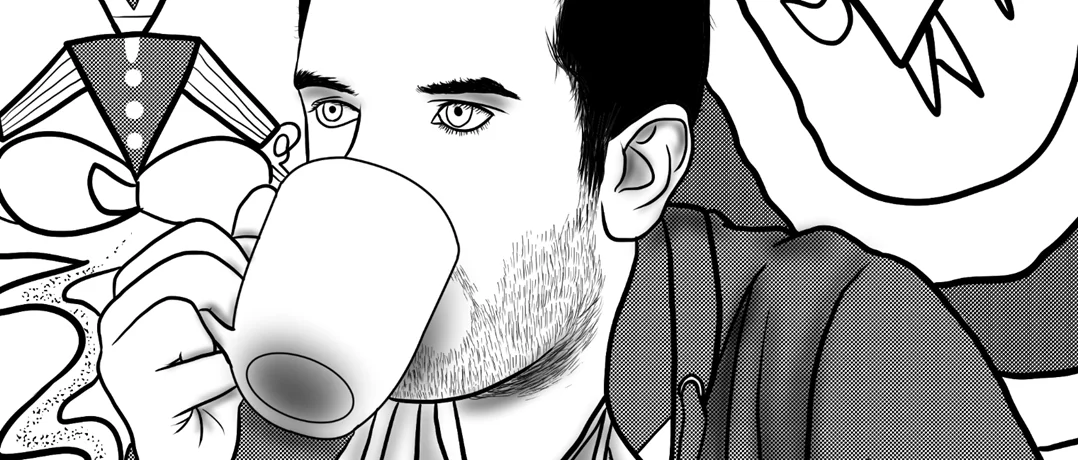
Illustration is everywhere in Lebanon. It appears in newspapers, advertising campaigns, restaurant menus, murals and product packaging, quietly shaping the way stories are told. Yet the artists behind these images have often remained in the background. Today, however, a growing number of Lebanese illustrators are transforming their passion into a profession, proving that illustration is much more than simply drawing. Karim Dagher, an in-house illustrator at The Beiruter, followed a different route. Inspired by childhood comics such as Tintin, The Smurfs and Garfield, he spent years creating his own characters before studying illustration and graphic design at ALBA. Today, he creates editorial illustrations that help readers engage with the stories behind the headlines.
Yasmina Keyrouz, on the other hand, began her journey almost by accident. While studying fashion, she started digitising the sketches she had always drawn by hand and uploading them to Instagram simply to organise her work. What began as a personal archive soon attracted commissions, turning a hobby into a full-time career. "I started for fun," she says. "Overnight people started asking me for projects and commissions, and that's when I realised I could actually make a living from this." Karim Dagher says, "I wanted to do more than just make drawings. I wanted people to see my work. It's about leaving your mark in the world." Although their careers began in different ways, both artists agree that illustration is about far more than artistic ability.
Behind every illustration is a process that often goes unnoticed. Karim Dagher’s workflow reflects the fast-paced demands of editorial illustration. Rather than spending months on a single campaign, he often has only a few hours to translate a news story into a compelling image. He begins with a mental picture, sketches different compositions and gradually refines the illustration until it communicates the article's central idea. Yasmina Keyrouz, by contrast, approaches her work with a slower, more layered process. Her personal projects often begin with an idea that appears unexpectedly during everyday life, while commercial commissions require extensive research, mood boards and careful planning before the first sketch is drawn. Some campaigns can take months to complete due to revisions and client feedback. "I don't want my illustrations to be shallow work that's just for likes and views," she says. "I like them to have depth." Despite their different rhythms, Karim Dagher and Yasmina Keyrouz both see illustration as a thoughtful process in which every colour, shape and composition serves a purpose.
Although illustration shares space with photography and writing, both artists believe it communicates in its own way. Dagher sees illustration as a language capable of expressing ideas that words sometimes cannot. While photography documents reality, illustration allows artists to simplify, exaggerate and reinterpret it. Keyrouz agrees, emphasising the openness of interpretation in her work. A photograph captures a specific moment and writing often directs readers toward a conclusion, but illustration leaves room for imagination, allowing every viewer to connect with an image differently. "The drawing becomes a message to the eyes of the audience," Dagher says. "My art has been growing up with me," Keyrouz adds. "People journal. I draw." Dagher believes that whether for an advertising campaign or a newspaper article, illustration should not simply accompany a story but become part of it. Keyrouz’s work reflects this idea through her recurring themes of Lebanon, fashion, politics, pop culture and everyday life, with women often taking centre stage in her illustrations.
As more illustrators enter the profession, originality has become increasingly important. Dagher believes that artistic identity develops gradually through repetition and experimentation. Every drawing, whether successful or not, contributes to shaping an illustrator’s personal style, making originality something built over time rather than discovered instantly. Keyrouz, however, stresses the challenge young artists face in avoiding imitation. She believes that technical skill alone is not enough; what makes an illustrator memorable is a distinct visual voice that cannot easily be replicated. Clients, she argues, are always searching for something unique.
Illustration remains a relatively specialised discipline in Lebanon, and both artists believe aspiring illustrators often have to teach themselves. Karim Dagher credits his education at ALBA with giving him strong technical foundations, but insists that real improvement only comes through constant practice and discipline. Yasmina Keyrouz’s development, meanwhile, has been largely self-taught, from traditional sketching to mastering digital tools. She believes that more workshops and structured programmes would help young artists enter the field more easily. "You have to dedicate yourself," Dagher says.
Artificial intelligence has become one of the biggest talking points in creative industries, but neither artist believes it can replace human creativity. Dagher argues that every line in an illustration reflects intentional choices made by the artist. While AI can imitate styles, it cannot replicate intuition, experience or craftsmanship. He also worries that growing reliance on AI could reduce opportunities in an already limited profession. Keyrouz adds that clients choose illustrators not just for the final image, but for their personal style and creative process. "The human touch," she says, "is what AI cannot replicate."
Although illustration remains a relatively small field in Lebanon, both artists believe it is steadily gaining recognition. Social media has helped illustrators reach international audiences, while publishers, brands and news organisations are increasingly embracing original artwork. Dagher’s work highlights the growing role of illustration in journalism, where visuals are becoming essential to storytelling. Keyrouz’s career, meanwhile, shows how personal creative work can evolve into collaborations with global brands.
Together, their paths reflect the evolution of illustration in Lebanon, from a largely overlooked discipline into an increasingly respected form of visual storytelling. As more Lebanese illustrators develop their own distinctive voices, they are proving that some of the country’s most compelling stories are told not only through words, but through the images that bring them to life.
