The destruction of Shamaa’s ancient citadel highlights the vulnerability of Lebanon’s cultural heritage amid ongoing war despite international protection.




The destruction of Shamaa’s ancient citadel highlights the vulnerability of Lebanon’s cultural heritage amid ongoing war despite international protection.

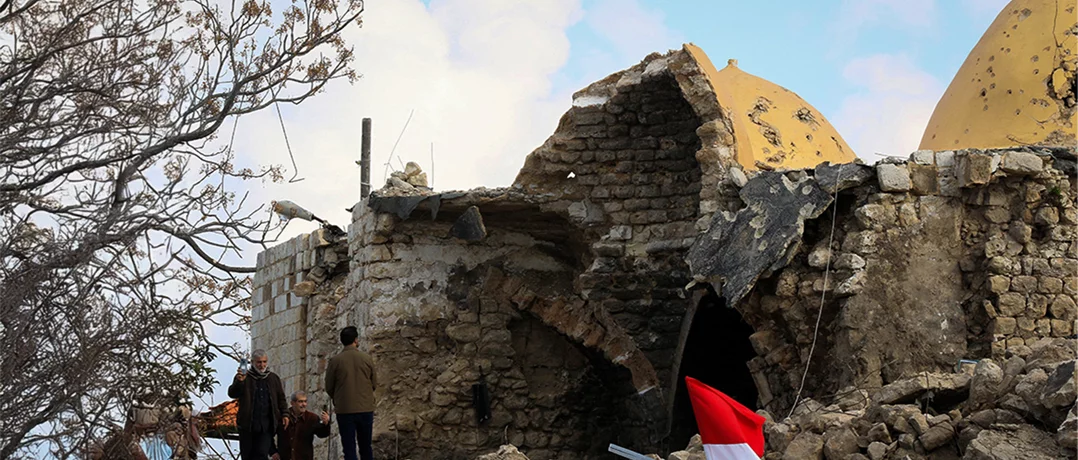
On a ridge above the ancient Phoenician coast, the citadel of Shamaa has presided over the comings and goings of civilizations for more than two millennia. Phoenicians, Romans, Crusaders, Mamluks, each left something of themselves in its stones.
Israeli forces shelled the area of the ancient citadel in the town of Shamaa, in the Tyre district of southern Lebanon, destroying a historic shrine that stood within the fortification complex. The citadel sits within a UNESCO-designated World Heritage zone, a status that is supposed to confer international cultural protection under the 1954 Hague Convention. The Citadel, alongside the archaeological site of Tyre, was also granted enhanced protection status under the Hague Convention in 2024, placing it among Lebanon’s most legally safeguarded heritage sites.
That protection, evidently, did not hold.
The Shamaa citadel is a sedimentary record of human settlement: each layer of stone corresponding to a different era of occupation, a different language spoken beneath its battlements.
Archaeological surveys of the Tyre district have repeatedly uncovered evidence of continuous habitation stretching back to the third millennium BCE. The hills around Shamaa bear the particular signature of successive defensive architecture: Phoenician dry-stone walls reinforced by Hellenistic ashlar masonry, later adapted by the Crusaders who recognized in the region's natural topography the same strategic advantages their predecessors had exploited for centuries before them.
The Roman period left perhaps the most visible imprint on the Tyre region as a whole. Roman Tyre, known as Tyros, was a prosperous provincial city whose hippodrome remains one of the largest ever excavated. But the influence of Rome extended into the hinterland as well, and fortified positions like the one at Shamaa would have served as administrative outposts for a coastal empire that needed to monitor and tax the movement of goods across its territories.
By the medieval period, the citadel at Shamaa would have been integrated into the defensive network that made Tyre one of the most stubbornly resistant cities in the Crusader wars. The Crusaders held Tyre for over a century after Saladin's campaigns swept the rest of the Levantine coast. The city's survival owed much to the geography of its surroundings, the rocky headland, the elevated watch posts on the hills inland, the narrow approaches that funneled armies into kill zones.
Within the citadel complex, a shrine had stood for generations, modest by the standards of its surroundings, but freighted with local significance. It had been destroyed once before, 2014 spillover of the Israel-Gaza war into southern Lebanon, and rebuilt by local residents. That act of reconstruction speaks to something important: in communities whose landscape has been repeatedly subjected to violence, restoring a historic site is an act of cultural persistence as much as conservation. Its destruction now is understood accordingly, not only as physical damage, but as an assault on collective memory.
The strike on Shamaa came amid the escalating conflict between Israel and Hezbollah in southern Lebanon. The Tyre district has been among the most severely affected areas, and its UNESCO designation has not shielded its cultural sites.
The citadel has outlasted Phoenicians, Romans, Crusaders, and Mamluks. Whether it can outlive this moment is now an open question.

