From Mirna Boustany's historic election in 1963 to a record eight women serving in Parliament today, the story of women in Lebanese politics reflects six decades of gradual but significant progress toward greater representation.




From Mirna Boustany's historic election in 1963 to a record eight women serving in Parliament today, the story of women in Lebanese politics reflects six decades of gradual but significant progress toward greater representation.

Political change is often measured by elections, governments and landmark legislation. Sometimes, however, it is reflected in something much quieter: who is able to take a seat at the decision-making table.
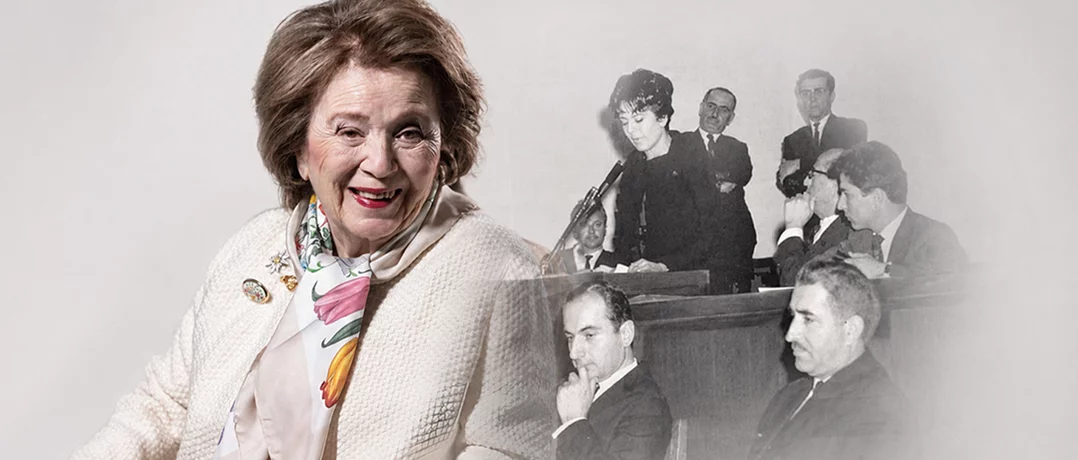
For Lebanon, one such moment came in 1963, when Mirna Boustany became the first woman ever elected to Parliament.
More than six decades later, women's representation has grown from one pioneering MP to a record eight elected women. The transformation has been gradual rather than dramatic, but each election has added another chapter to the story.
When Mirna Boustany entered Parliament, she did so under circumstances few could have anticipated.
Born in 1937, she received her early education at the Collège Protestant Français before earning a degree in psychology from the University of Lyon in 1958. At the time, her future appeared more likely to unfold in academia, business or public service than in electoral politics. Politics, after all, remained an overwhelmingly male arena, and no woman had ever held a seat in the Lebanese Parliament.
That changed in 1963 following the sudden death of her father, Emile Boustany, one of Lebanon's leading businessmen and a Member of Parliament representing the Maronite seat in Chouf since 1951. His death in a plane crash triggered a by-election to fill the remainder of his parliamentary term, placing his daughter unexpectedly at the center of a historic political moment.
When her only rival withdrew his candidacy, Mirna Boustany was declared the winner, becoming the first woman ever elected to the Lebanese Parliament. Newspapers across the country reported the milestone, with one headline simply announcing: "Mrs. Mirna Al-Bustani has become the first woman to enter the Lebanese Parliament."
Yet contemporary newspaper reports suggest that Boustany herself viewed her election as the beginning of a responsibility rather than the culmination of an achievement. Within days, she had resumed a full schedule of public engagements, attending a conference on technical education in Jounieh, participating in committee discussions on vocational education and preparing for her first press conference, where she intended to present the priorities she hoped to pursue inside Parliament.
Although her parliamentary term came to an end with the 1964 general elections, its historical significance endured. For the first time since Lebanon's independence, the country's legislature was no longer an exclusively male institution, and a precedent had been established that future generations of women would continue to build upon.

Boustany's election may have been a historic first, but it did not happen in isolation. By the time she entered Parliament in 1963, Lebanese women had already spent more than a decade asserting their right not only to vote, but to stand for elected office in a political system that remained overwhelmingly dominated by men.
After women secured the right to vote and run for Parliament in the early 1950s, a handful of candidates began doing something that had rarely been imagined before: placing their names on parliamentary ballots. Their campaigns unfolded in an era when female political leadership was still widely viewed as the exception rather than the norm, making each candidacy an act of quiet determination.
Among the earliest was Laure Tabet, who ran for the Maronite seat in Beirut during the 1957 parliamentary elections. Three years later, Munira al-Solh became the first woman to contest a Sunni seat in Beirut, while Renée al-Hajj entered the race for the Maronite seat in Jezzine. Throughout the 1960s and early 1970s, other women, including Emily Fares Ibrahim, Nuhad Sa'eed, Zahiyah Salman and Nazira Tarabay, continued to put themselves forward as candidates, despite facing an electoral landscape that offered few opportunities for success.
None of them won a parliamentary seat.
Yet measuring their contribution solely by electoral results would overlook their broader significance. Every campaign challenged long-standing assumptions about who could represent the public, introduced voters to the idea of women seeking elected office and helped normalize women's participation in national politics. By the time Mirna Boustany entered Parliament, she was making history, but she was not beginning the story.
For many years, women remained a small presence in Parliament, navigating a political landscape shaped by sectarian power-sharing, established parties and influential family networks that left little room for newcomers.
The post-Civil War elections marked the beginning of a new chapter. When Lebanon returned to the polls in 1992, three women were elected to Parliament: Nayla Moawad in Zgharta, Bahiya Hariri in Sidon and Maha Khoury Asaad in Byblos. Their victories represented more than an increase in numbers. For the first time since Boustany's historic election, women's presence in Parliament was no longer an isolated milestone but an emerging feature of Lebanon's political life.

Over the years that followed, female representation continued to grow, albeit gradually. Nayla Moawad and Bahiya Hariri remained influential voices across successive legislatures, while other women, including Ghenwa Jalloul, Nuhad Sa'eed, Gilberte Zwein, Setrida Geagea and Solange Gemayel, secured parliamentary seats and helped broaden women's participation in national politics.
Each election added new names, new experiences and new perspectives to the legislature. Progress rarely came in dramatic leaps, but rather through a series of incremental gains that slowly reshaped the face of Parliament. By the 2005 elections, six women had been elected, the highest level of female representation Lebanon had recorded at the time and another sign that what had once been an extraordinary exception was becoming a more familiar part of the country's political landscape.
By the late 2010s, women's political participation was no longer measured solely by the number of seats won. Another trend was becoming increasingly visible: more women than ever before were choosing to enter the electoral arena, bringing with them a wider range of experiences, professions and political perspectives.
The 2018 parliamentary elections reflected that momentum. A record 113 women submitted their candidacies, the highest number in Lebanon's history at the time. They contested seats across the country on the lists of established political parties, independent coalitions and emerging movements, illustrating how women's participation had expanded far beyond the handful of pioneers who first challenged the political status quo decades earlier.
The October 17, 2019 uprising added a new dimension to that transformation. It brought a generation of politically engaged women into the public spotlight, many of whom had built careers in academia, journalism, activism and civil society rather than through Lebanon's traditional political parties or established political families. The movement also reshaped public debate around representation, accountability and political participation, creating new opportunities for independent voices to enter politics.
Those changes became increasingly visible in the 2022 parliamentary elections, when Lebanon elected eight women to Parliament—the highest number ever to serve in a single legislature. Yet the significance of that election extended beyond the record itself. Alongside experienced parliamentarians such as Setrida Geagea and Inaya Ezzeddine were newcomers including Najat Saliba, Halima Kaakour and Cynthia Zarazir, whose election reflected the increasingly diverse paths through which women were entering public life.
Compared with the years immediately following Mirna Boustany's election, the political landscape had changed profoundly. Women were no longer viewed as exceptional candidates or symbolic breakthroughs. They had become an established part of Lebanon's political life, representing different generations, professions and political currents. Their growing presence reflected not only changing electoral outcomes, but also a broader evolution in how political leadership itself was imagined.
While women remain underrepresented in Lebanon's 128-member Parliament, the trajectory over the past six decades reveals a clear and encouraging evolution. What began with a single historic breakthrough in 1963 has gradually become a broader movement, with more women contesting elections, more voices entering the legislature and more diverse backgrounds represented in public life.
When Mirna Boustany took her seat in Parliament, she stood alone. Today, women serve across political parties, represent different regions and professions, and contribute to shaping the country's future. The journey toward greater representation is far from over, but it is no longer defined by one pioneering figure. It is the story of generations of Lebanese women who, election after election, have continued to expand what is possible.