



The extraordinary journey of François de Galaup de Chasteuil, a seventeenth-century French scholar who abandoned European life to become a Maronite hermit in Mount Lebanon, where he was transformed from a foreign visitor into a revered spiritual figure of the Qadisha Valley.
The French hermit who chose Mount Lebanon

Even in death, François de Galaup de Chasteuil was not allowed to lie down.
When the French hermit died in the Qadisha Valley in May 1644, the Carmelite monks of Mar Elisha prepared to bury him lying flat, according to Latin custom. But the Maronite priests who had gathered for his funeral objected.
By then, Chasteuil was no longer simply a Frenchman living among them. After more than a decade in Mount Lebanon, he had adopted their dress and lived among their clergy and hermits. As such, the Maronite priests insisted that he be placed sitting upright. Having preached penance and austerity through the severity of his own life, they wanted him buried, as his seventeenth-century biography put it, in the posture of a man “still teaching after his death.”
And so, the Frenchman who had come to Lebanon as a foreign scholar was lowered into his tomb seated, buried by the Maronites as a man who had become part of their own religious world.
How a Provençal scholar became a figure of the seventeenth-century Lebanese mountains is the story of an unusual journey from the intellectual circles of Europe to the monasteries and caves of the Qadisha.
From Provence to Mount Lebanon
François de Galaup de Chasteuil was born in Aix-en-Provence on August 19, 1588 to a noble family. He received the education of a man of his background, studying Greek, Latin literature, and philosophy before earning a doctorate in law at the University of Aix. But law held little attraction for him. He increasingly turned instead to languages, particularly Hebrew, which he studied first in Aix and later under a rabbi in Avignon.
The Levant increasingly appeared to him as a place where he could pursue both aims that had come to dominate his life: studying Scripture through the scholars and languages of the East and withdrawing into a more austere religious existence.
In July 1631, he left Marseille with the French ambassador, the Comte de Marcheville, bound for Constantinople.
Chasteuil remained there for nearly ten months, immersing himself in study. Jewish scholars came to discuss Hebrew and Scripture with him, while Greeks, Armenians and Arabs also entered his circle. His reputation even reached Ottoman scholars, who secured permission for him to visit the sultan’s library, normally closed to foreigners.
But Constantinople also deepened the transformation already underway. Chasteuil began eating only once a day, increasingly withdrew from company and experimented with the solitary life he intended eventually to lead. He came to believe that the Ottoman capital, dominated in his eyes by commerce and worldly life, could not provide the retreat he wanted. Mount Lebanon, on the other hand, could.
On July 26, 1632, Chasteuil left Constantinople for Rhodes. From there he crossed the eastern Mediterranean by way of Cyprus, reaching Saida on September 6. The French consul and merchants there received him and helped prepare the final stage of the journey.
Five days later, Chasteuil set out for Mount Lebanon. Leaving on September 11, Chasteuil reached Beirut the same day. The following evening, he travelled north into Mount Lebanon, passing through Hasroun before reaching Ehden on September 16, 1632.
Ehden: Entering the Maronite World
Ehden was where Chasteuil stopped searching for a place to withdraw
He had passed through Hasroun on his way partly because Syriac was still spoken there, but continued to Ehden specifically to meet its archbishop, Georges Omeira. Chasteuil wanted to deepen his Syriac and learn the foundations of Arabic. The archbishop received him into his own house, where the two remained together for around forty days, exchanging knowledge on languages and Scripture.
What Chasteuil encountered around Ehden was a Christian society very different from the one he had left in Provence, with Syriac remaining the language of the liturgy. The Maronite Church maintained close ties with Rome and was headed by a patriarch residing at Qannoubine, with bishops and priests spread through the mountain communities. Many clergy lived in considerable poverty, cultivating land, or working with their hands to support themselves, while monastic life was marked by fasting, prayer and austerity.
For Chasteuil, these customs finally offered the kind of life he had been searching for.
He chose to remain in Ehden, both to perfect his Syriac and to pursue the religious withdrawal that had brought him east. More importantly, he decided that, rather than simply study the Maronite, he wanted to live among them.
Chasteuil’s retreat into the Maronite world, however, did not remove him from the political order governing Mount Lebanon.
For months after settling in Ehden, he postponed the formal visits expected of him because he was still waiting for gifts from France. Local custom, he had learned, made it improper to visit a person of rank without bringing something to offer. Only after seven months did the presents arrive and Chasteuil begin making his visits.
His first was to Emir Fakhr al-Din, who received the French scholar with respect. Chasteuil then visited two unnamed Maronite brothers serving as governors under him, probably from the influential Khazen family, before continuing with the bishops and patriarch
The patriarch kept Chasteuil with him for several days, during which the Frenchman laid out his intention to abandon worldly life and remain in Mount Lebanon as a recluse. He eventually knelt at the patriarch’s feet, asking to be received under his spiritual authority. The patriarch approved the plan, blessed him, and sent him back to Ehden to begin the life he had crossed the Mediterranean to find.
From Monsieur de Chasteuil to El Habis
By the spring of 1633, with the patriarch’s blessing, he placed himself under the direction of Pere Elie, a religious of the Order of Saint Anthony and priest of Ehden, entrusting him with the spiritual discipline of the retreat he was about to undertake.
Chasteuil dismissed the servant who had accompanied and assisted him, considering even that comfort incompatible with the poverty he had chosen. He exchanged his clothes for rougher garments like those worn by the poorest inhabitants of the mountain. He kept local shoes and wore a simple bonnet wrapped in a coarse, torn cotton scarf. Then he distributed all the money and linen he still possessed to the poor of Mount Lebanon.
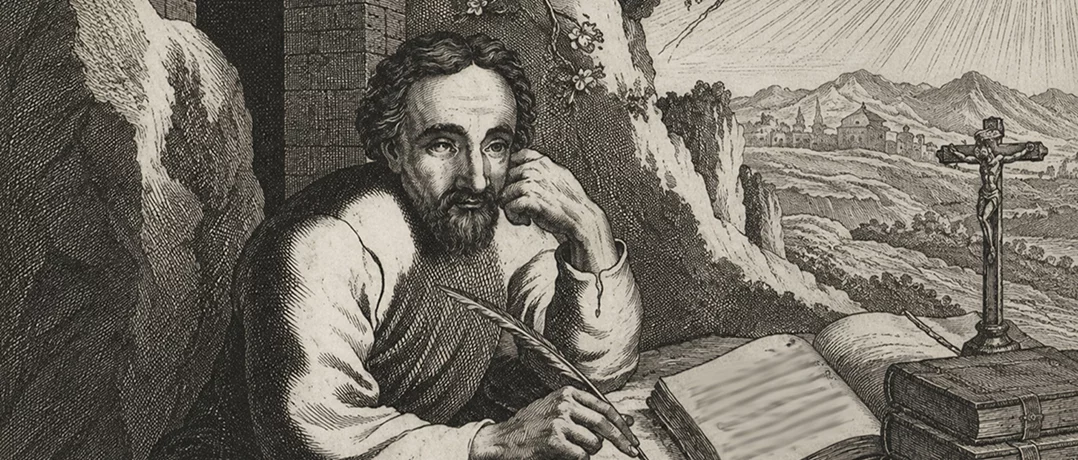
His new home matched the transformation. Chasteuil deliberately chose the poorest and least comfortable cell available. It was cut into the rock, with a single window looking out over a precipice. Its principal piece of furniture was a worm-eaten chest that served both as his table and as storage for his books and papers. He would not even allow a lock to be fitted to it, fearing that locking something away would revive the idea that anything still belonged to him.
Once inside, he resolved not to leave except under absolute necessity. It was perhaps the clearest indication that Chasteuil had ceased to be simply a French visitor. The people around Ehden no longer needed the name Galaup de Chasteuil. To them he was El Habis, the man who had shut himself away.
And as stories about his austerity and holiness spread across the mountain, even that name changed. He became El Kadis: the saint.
A reputation across the Mountain
The more Chasteuil tried to disappear, the more people came looking for him.
His reputation spread beyond Ehden. Men, women and children travelled from villages across Mount Lebanon to seek his prayers and blessing, while pilgrims and religious passing through Tripoli, Saida and Beirut reportedly diverted their journeys to visit his cell at Saint-Serge. Even some Muslims joined the crowds around him.
François Marchety, the Marseille priest who wrote Chasteuil’s biography in 1666, also records numerous stories of healings and miracles from these years. Such accounts are difficult to verify historically, but they show how widely Chasteuil’s reputation had spread.
The most extraordinary claim came after the death of Patriarch Georges Omeira. According to the biography, people came to Chasteuil urging him to accept the patriarchate himself. He reacted with alarm and refused, insisting that he wanted only to remain in solitude.
The claim has yet to be corroborated from Maronite ecclesiastical records, but its presence in a biography written only two decades after his death illustrates the authority Chasteuil had acquired in local memory.
Mar Elisha: The Final Retreat
By the early 1640s, the mounting violence around Ehden linked to Ottoman forces had become difficult to ignore. The Discalced Carmelites of Mar Elisha, deeper in the Qadisha Valley, repeatedly pressed Chasteuil to leave his exposed cell and join them. Eventually, he agreed.
There, on the night of Pentecost, 15 May 1644, after battling a fever, Chasteuil died while praying.
His first grave was later replaced by a larger stone sepulchre, around eight feet high. His body was placed inside in the same seated posture. Across the monument were inscriptions in French, Latin, Arabic and Syriac.
Those four languages marked the different worlds that had converged around him: the France he had left, the Latin Church from which he came, and the Lebanese mountain into which he had gradually disappeared.
-
-

-
Nami El KhazenJournalistFocusing on geopolitics and international affairs.
-
