


A Beirut-born artist transforms war, displacement, and personal upheaval into a growing initiative that helps children process trauma through art.
The Lebanese artist who heals amid chaos

Abed Al Kadiri, Beirut-born artist, has always moved between worlds: between Beirut and Paris, between gallery walls and shattered neighborhoods, between fine art and urgent humanity. Speaking to The Beiruter, he says "There are moments," "when I feel like a civil defense truck. I just want to turn that siren on and go, whatever the circumstances."
Kadiri graduated from the Lebanese University's Institute of Fine Arts in 2006, the same year the July War forced him to leave Lebanon for the first time. He spent a decade abroad before returning, only to leave again after the catastrophic Beirut port explosion of August 2020. He has now lived in Paris for six years, caught perpetually in that orbit that defines so many Lebanese artists: drawn home by love and memory, pushed away by catastrophe.
How art became a tool for survival
It was the 2020 explosion that gave birth to the initiative that would define him. His gallery was destroyed in the blast. The building's architect was killed, along with four others. In the rubble and the grief, Kadiri found himself asking what art was actually for. "I discovered in 2020 that art yes, its purpose is aesthetic, intellectual, cultural. But if it can also have a direct humanitarian purpose, and become a tool from one human being to another, then it becomes something else entirely."
The answer became “Today I Would Like to Be a Tree”,a rolling initiative that Kadiri has now carried across three countries and three crises. In 2020, he painted two large murals in Beirut, sold them, and used the proceeds to repair the windows and doors of fifty damaged apartments. When the war in Gaza began, he did it again, this time in Paris, raising funds for Gazan children. And when the latest Israeli assault on Lebanon erupted, he found himself grounded in Beirut with his fourteen-year-old son, living through a third iteration of the same nightmare. He launched the initiative once more, this time from a mural he created in Qatar. The proceeds helped more than two hundred displaced families.
War at home, and the shift in perspective
This time, though, something shifted. “My 14-year-old son lives here with his mother he says. I felt they needed to be somewhere safer. I was also trying to keep working and painting, and to have my son around me.” But after a few days, the war came closer. “The hotel right in front of my home was hit, and from there our own displacement began.” What followed was a period of constant movement and uncertainty. “We started moving from place to place. The situation was very difficult, everyone was scared. Eventually, we found a place with a Christian family who hosted us, even though the situation socially was very complex at the time.” In that experience, he says, something deeper surfaced. “Having my son in these conditions made the experience even more intense. Art in that phase became a kind of disconnection, or a way to hold myself together.”
10 schools, 350 children, and a growing goal
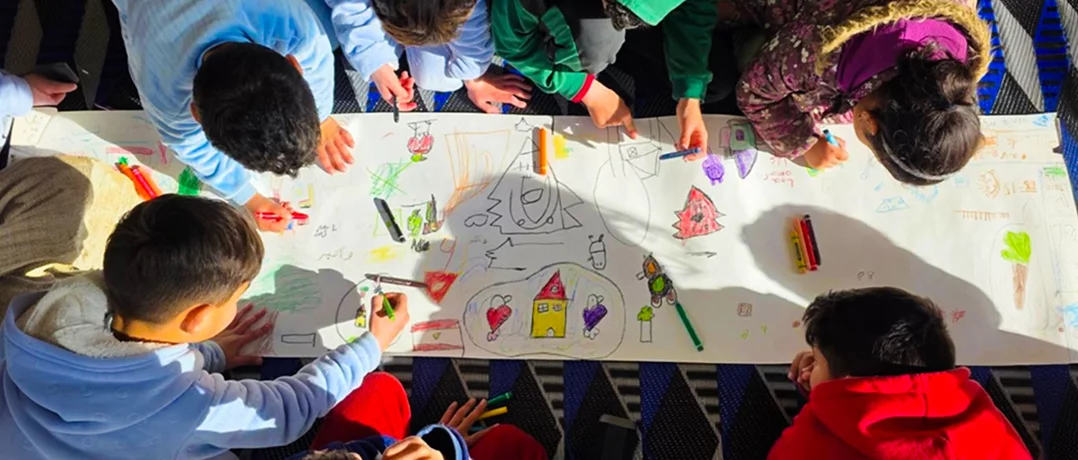
He wanted to then bring this to these children. “These are children who have done nothing wrong. They are suffering, they have been displaced from their homes, and none of it is their fault."
He now works with 10 schools and has reached approximately 350 children, mmostly from villages in the South that have been devastated. His goal is 1,000. "I want the number to mean something when the project goes to exhibition. I want it to carry its weight."
The second phase of the project is where Kadiri's world as artist and publisher converges. The children's drawings will be transformed into artworks, he will work on the final scrolls himself, and he is inviting fellow artists who have lived through war or displacement to add their own interventions. He tells The Beiruter, “These scrolls will become accordion books, sold to raise funds that go directly back to the children's communities.” He has previously raised between 30,000 to 60,000 dollars per initiative. He intends to do so again.
A quieter injustice, and a personal reckoning
There is one more thread to his story that Kadiri names carefully. When the war began and displacement rippled across Lebanon, he witnessed a quieter violence alongside the bombs: the refusal of some communities to house Shia families fleeing the south and the Dahieh suburb. "As someone who has built his life and art around crossing sectarian lines, he found this recent discourse profoundly disturbing. "I have friends who are Shia. Many of them don't support Hezbollah. The way an entire group of people was treated because of where they were born, that was deeply unjust to me."
Art as infrastructure for crisis
He does not dwell. There are children to reach, books to make, murals to paint. And there is, underneath all of it, a conviction that has only grown harder and brighter through each crisis he has lived: that art, channeled correctly, is not decoration for peaceful times. It is infrastructure for the ones that aren't. He says, "We're all going to need time to process the traumas we're living through," he says. "All of us. But right now, what our conscience demands is that we channel our energy toward helping. That's what I'm trying to do. I just hope I can keep going."
-
-

-
The Beiruter
-
