In Jezzine, generations of artisans keep Lebanon’s iconic phoenix cutlery alive, blending history, resilience, and hand-forged beauty.




In Jezzine, generations of artisans keep Lebanon’s iconic phoenix cutlery alive, blending history, resilience, and hand-forged beauty.

Long before cutlery became a household object, it was a marker of power, craft, and identity. The Phoenicians were among the first to manufacture bronze knives, before moving on to more noble metals such as silver and gold. One of the most striking examples of this early mastery was discovered in a royal tomb in Byblos: a remarkably modern silver knife inlaid with gold, dating back to the 19th century B.C. Even millennia ago, Lebanese craftsmanship balanced function with beauty.
Today, that ancient legacy lives on in Jezzine, a town in southern Lebanon. Surrounded by mountains, orchards, and waterfalls, Jezzine has become the beating heart of Lebanon’s traditional handicraft cutlery, a place where metal, bone, and memory converge.
Jezzine’s workshops work with materials both humble and refined: buffalo, goat, and sheep horns, ivory, stainless steel, silver steel, and copper. What makes Jezzine cutlery instantly recognizable, however, is its iconic handle design. Each piece is crowned with a sculpted bird, often described as a phoenix, scratching its chest with its beak. Its wings are fashioned from copper, its head topped with a small tuft of bone dyed red, and its body carved meticulously from horn or bone. No two birds are ever exactly alike.
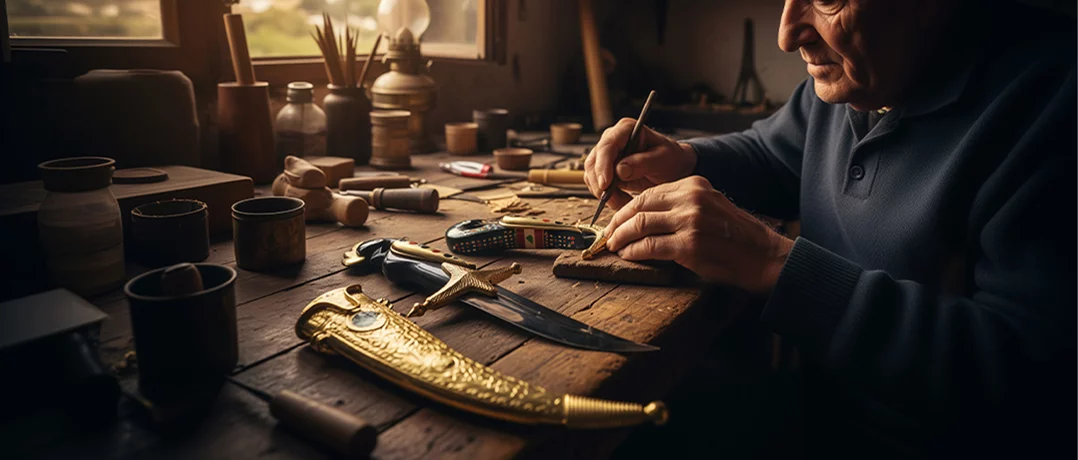
Many workshops still fashion each piece entirely by hand, from the first cut to the final polish. Only around ten families in Jezzine have mastered this trade, passing it down through generations. A skilled artisan produces no more than six or seven pieces per day, a reminder that this is not mass production, but preservation.
The story of Jezzine cutlery formally begins in 1770, when the Haddad family settled in the town. At the time, production focused on army rifles, knives, and steel-blade swords. By the 1930s, artisans expanded their craft, introducing bird-headed handles made of bone and buffalo horn, inlaid with colored bone and brass. These intricate handles soon adorned spoons, forks, knives, paper-knives, and ceremonial daggers.
So revered did this craft become that Lebanese presidents and officials began offering Jezzine cutlery as diplomatic gifts to dignitaries across the world, a tradition that dates back to the Ottoman sultans of the 18th century. Each piece carried more than utility; it carried history, culture, and an unmistakable sense of Lebanon.
The phoenix motif is central. While the bird’s design varies from family to family, its symbolism remains unchanged: rebirth, resilience, and continuity. Traditionally, black phoenix handles were carved from cow or bull horns, dusty brown when raw, transforming into a deep jet-black when polished. White phoenix handles were made from camel bone, sourced from Egypt, Iraq, Syria, and within Lebanon itself, from Beirut to Tripoli to Jezzine. Stainless steel blades were often imported from Italy or France, while brass and silver inlays were sourced locally to support Lebanese production.
In recent years, sourcing natural materials has become increasingly difficult due to rising eco-consciousness and the protection of animal species. Natural bone cutlery requires nearly double the labor and comes at almost twice the price. Crafting a single phoenix handle from natural materials can take up to 45 minutes, from whittling to polishing. Even then, a full workday yields only eight to twelve pieces per artisan.
There is something profoundly grounding about creating an object by hand, an object that feels permanent in a country defined by impermanence. These still, carefully crafted pieces have traveled far beyond Jezzine, finding homes across Lebanon and the world. Like the phoenix they depict, these objects carry loss, resilience, and hope within their form. A small bird, forged by hand, that dares to soar, much like this little piece of land it comes from.

