



The secret life of dating apps in Lebanon

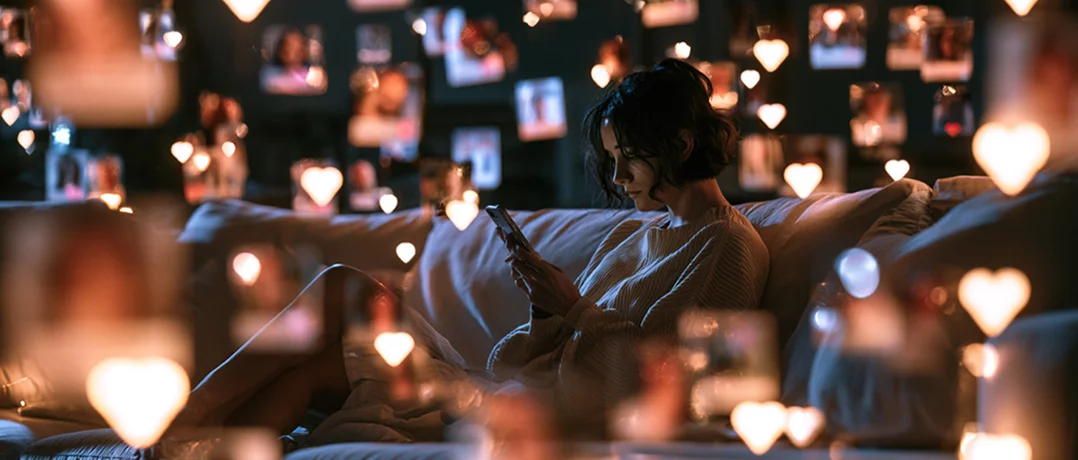
Rarely do people in Lebanon admit to being on a dating app. And yet, somehow, many seem to be on one. It is one of the country's contradictions, a place where "you'll meet someone eventually" is offered as reassurance to a generation that increasingly can't figure out where "eventually" is supposed to happen. Friends have emigrated. Social circles have calcified into the same familiar faces. Work hours have swallowed the evenings once spent meeting strangers. Into that gap, a screen has slid itself, used by nearly everyone, confessed to by almost no one.
Three people agreed to talk honestly about what they are actually doing when they open the app, and why so few people will admit to doing it at all.
Rita, 24: "Everybody is on the app but nobody wants to be an app person"
For Rita, downloading a dating app wasn't a last resort so much as an obvious response to a shrinking world. "In Lebanon, especially if you are in your twenties, your social life can become incredibly repetitive," she said. "Half the people I knew growing up are abroad. So, I thought, why not?"
What frustrates her is the double standard attached to admitting it. "Nobody thinks it's desperate when you meet someone at a bar and exchange Instagram accounts. How is this fundamentally different?" she asked. "The only difference is that the app makes your intention more obvious... In Lebanon, people are very uncomfortable admitting that they want something."
Rita is candid about the app's emotional undertow, that what she's chasing isn't always romance, exactly. "Sometimes you have had a terrible day and you get five likes and suddenly you're like, okay, maybe I'm not completely undesirable. That's not necessarily healthy, but it's real." She described the appeal as choice, hundreds of people, technically available, a few taps away, and in the same breath, names its trap. "It's also an illusion of choice. You can have 50 conversations and still feel completely alone." She once spent two months falling for a man's voice and stories through her phone, only to feel nothing when they met in person. "I think we sometimes use them to build fantasies. And then we get disappointed when the human being doesn't match the fantasy."
Her diagnosis of the country's dating culture is blunt, the apps are filling a desire that's lost its usual outlets. "People still want love, but the old ways of finding it are disappearing... They're replacing the opportunities to encounter people."
Natasha, 30: "Hope is vulnerable"
Natasha's relationship with dating apps began in secrecy. "I didn't tell anyone for months. I was worried someone I knew would see me," she said. "It's ridiculous because I'm 30 years old... but somehow being seen on a dating app felt like publicly announcing, 'I haven't found anyone.'" She traced the shame to a specific cultural pressure placed on Lebanese women approaching thirty, the barrage of are you seeing anyone, why are you still single, that a dating app seems to answer out loud. "It feels like you're confirming the thing you're trying to hide, yes, I'm looking. Yes, I want someone."
Her worst experience on an app hardened her instincts without souring her hope. She matched with a man who grew evasive about his weekends; a search of his tagged photos revealed a wife. "Married. Not separated. Not 'complicated.' Married," she said. When she confronted him, he tried to hand her his guilt. "He said their marriage was basically over and that he was only staying because of family pressure. I told him that whatever was happening in his marriage was not my responsibility." She's since concluded the apps just give dishonest people another place to operate."
Beneath the caution, Natasha names a fear of expiration. "There can be this fear that your romantic value has an expiration date," she said. "An app can temporarily silence that voice." But only temporarily, "a match doesn't actually solve loneliness. Sometimes it makes you more aware of it." She keeps using it anyway, for a reason she says most people are too embarrassed to admit to themselves. "I haven't given up on love. That's the simplest answer... Using a dating app requires you to admit that you are hopeful. And hope is vulnerable."
Karim, 29: "The app isn't the relationship. It's just the door"
For Karim, the apps are a practical answer to a shrinking social map. "When I was 20, I met people at university. Then people graduated, moved abroad, started working. Your circle gets smaller," he said. He's skeptical of the nostalgia attached to meeting someone "naturally." "People romanticize meeting someone naturally, but what does that actually mean? At work? At a wedding? Through friends? At a bar? All of those are social mechanisms. The dating app is just a new one."
He's frank about the app's less romantic uses, a way to avoid sitting alone with his own thoughts at night. "You aren't necessarily looking for a girlfriend. You just don't want to be alone with your thoughts... Then when nobody replies, you feel rejected by people you don't even know." He knows the mechanism isn't healthy even as he uses it, describing a small, engineered dopamine hit that can just as easily curdle into rejection.
Karim has also seen the apps work as intended, he dated someone for months after matching, and watched the platform dissolve into irrelevance once the relationship became real. "Once we became serious, we basically stopped behaving like people who met online... That's when I realized the app is just the door into the relationship." His biggest complaint is the dishonesty they enable through vagueness, everyone hiding their actual intentions behind curated photos and interchangeable bios. What he's ultimately looking for, he said, is simple. "Someone I don't have to perform for."
Loneliness with Wi-Fi
Strip away the stigma, and what Rita, Natasha, and Karim describe is a generation improvising, often shamefacedly, in a country that has made the old paths to love harder to walk. Emigration has thinned the room. Work has eaten the evenings. And a culture that still asks why are you still single has left little space to say, honestly, I'm looking, and I don't know where else to look.
Perhaps that is the real secret life of dating apps in Lebanon, beneath the swipes, curated photographs and carefully concealed profiles is the old human desire to be found. The screen has simply become another place to look, not necessarily for perfection, or even certainty, but for the possibility that somewhere behind another profile is someone worth loving.
-
-

-
The Beiruter
-
