



Once a symbol of Beirut’s transformation into a modern capital, the Small Serail was demolished in the 1950s, leaving behind a lasting absence in the city’s architectural memory. This article retraces the story of the lost landmark, its Ottoman-era design, its role in shaping Martyrs’ Square, and the question of whether Beirut can modernize without erasing its past.
The Small Serail: The landmark lost to modernization
The Small Serail: The landmark lost to modernization
By Fadi Badran | August 30, 2026

Reading time: 5 min
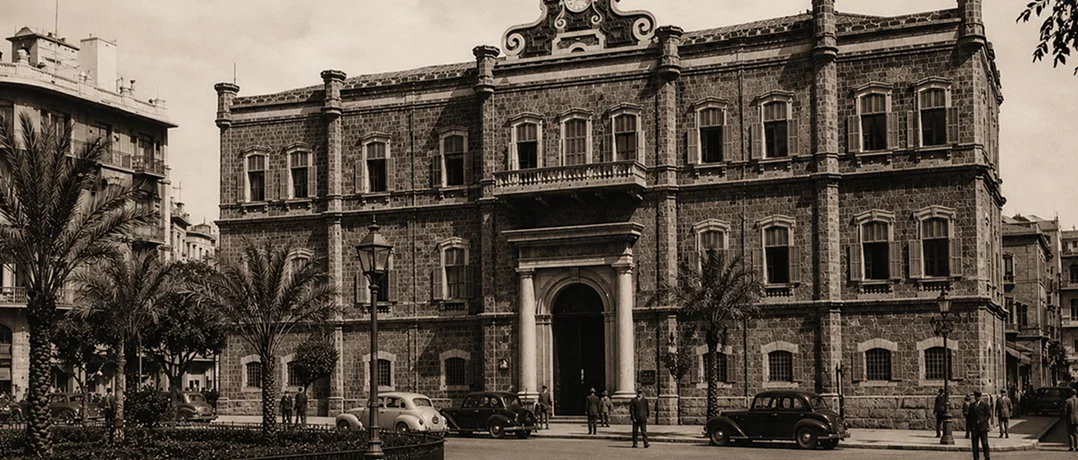
In old cities, empty spaces are not always simply vacant areas; sometimes they are the traces of a building that was removed, leaving behind an absence heavier than its presence. At the northern edge of Beirut’s “Martyrs’ Square,” where buildings, projects and “modernization” plans have successively transformed the area, stood one of the capital’s most prominent landmarks of the late 19th century: the Small Serail, or “Dar al-Hokouma” (Government House). This building did not fall because of war or an earthquake but was demolished by an official decision in the early 1950s, causing Beirut to lose a fundamental part of its architectural memory and the identity of its public square.
The Small Serail was built in the early 1880s and inaugurated in 1884 during the rule of Governor Ahmed Hamdi Pasha. Its design was overseen by Beshara Effendi, the province’s engineer, to serve as the headquarters of administration and governance in a strategic location overlooking “Burj Square,” which later became known as “Martyrs’ Square.” Local sources mention that the building contained around eighty rooms, and that the “Hamidiye Garden” was created in front of it, making it part of an integrated urban composition that brought together the seat of authority, the garden and the public square.
The importance of the Small Serail did not come only from its administrative function, but also from its architectural language. It reflected a period when Beirut was transforming from a city enclosed by its old walls into a modern regional capital and a thriving Mediterranean port. Its design was based on a long and balanced stone façade, centered around a prominent official entrance, while its regular windows and geometric rhythm gave it a majestic classical character.
At the top of the building appeared balconies, corner towers and details inspired by European fortress architecture, combining neoclassical symmetry with medieval-inspired ornamentation, within an eclectic style that characterized several Ottoman public buildings of that period. An academic study indicates that it was completed around 1880–1882, following a neoclassical style enhanced with medieval details that were popular in Europe at the time.
In this sense, the Small Serail was not an Ottoman building isolated from its surroundings, but rather a witness to the birth of modern Beirut. Employees, merchants and travelers passed before it, carriages and later trams moved around it, and people gathered in the garden and the square beneath its shadow. Its presence helped define the northern edge of “Burj Square” and gave it a clear urban framework. The square was not merely an open space, but the “great room of the city,” whose walls were created by public buildings, markets, cafés and the faces of its people.
During the French Mandate, plans emerged to reorganize central Beirut and open “Martyrs’ Square” toward the sea. Because of its location, the Small Serail was at the heart of these visions. But what was presented under the title of expansion and modernization eventually led to the removal of one of the most important buildings that gave the square its character.
The Small Serail was demolished in 1950, while some local references date the completion of the demolition to 1951. Modern buildings were later constructed on its site during the 1950s, most notably the Rivoli building, without the open and permanent connection between the square and the sea, which had been used to justify the demolition, ever truly being achieved.
The tragedy of demolishing the Small Serail lies in the fact that the loss was not merely one of stone and decoration, but an interruption in the city’s story. Heritage buildings preserve traces of political and social transformations, even when they belong to periods that Lebanese society may assess differently. Preserving an Ottoman building does not mean glorifying Ottoman rule; rather, it means recognizing that Beirut’s history was formed through successive layers, and that erasing one of these layers makes the understanding of the city poorer and more fragile.
The Small Serail represented a transitional phase in Beirut’s transformation into an administrative and political center, while also embodying an early attempt to organize public space around state institutions. Had it remained, it could have taken on new cultural or civic functions, becoming a museum of the capital’s memory or a public center connecting generations with the history of Martyrs’ Square. But the logic of demolition prevailed over the logic of adaptive reuse at the time, causing a rare opportunity to combine urban development with the protection of identity to be lost.
When excavations in downtown Beirut during the 1990s revealed the foundations of the Small Serail, the building returned to the spotlight, not through its façades and towers, but through its silent remains underground. Yet these remnants remain capable of reminding us that heritage never truly disappears as long as someone continues to tell its story.
Restoring the story of the Small Serail today is not merely an act of mourning for a lost building, but an invitation to reconsider our relationship with Beirut: Do we see it as land that can endlessly be erased and rebuilt, or as a city with a memory and a right to preserve its landmarks?
The Small Serail was demolished, but the emptiness it left behind remains present in the image of a square still searching for its boundaries and identity. Perhaps the most important lesson from its disappearance is that modernizing cities does not begin by removing their past, but by understanding it and integrating it into their present. A Beirut that preserves its buildings is not trapped by history; rather, it becomes more capable of creating a future that reflects who it is.
