



A disappearing Lebanese craft, kept alive by two cobblers who refuse to let generations of skill, memory, and repair culture vanish.
The vanishing craft of Lebanon's cobblers

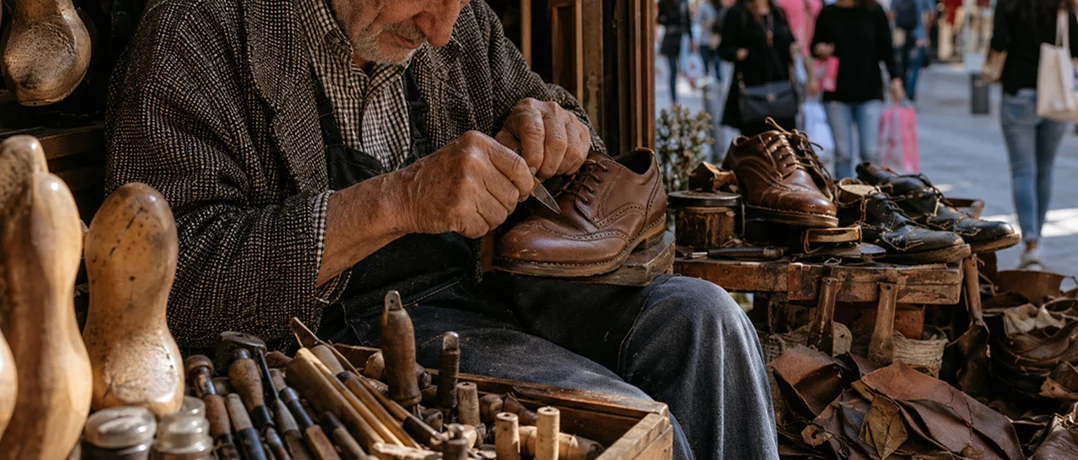
Shoe repair is one of the oldest trades in human history, with evidence of cobblers and leatherworkers found as far back as ancient Egyptian tombs. In Lebanon, the craft took particularly deep root, during the Ottoman era, Tripoli, Beirut, and Sidon each developed distinct leatherworking specialties, from fine slippers and sandals to saddles and harnesses, while districts like Bourj Hammoud grew into dense manufacturing hubs built in part by Armenian refugee artisans in the 1920s and 1930s. Today, that once-thriving trade survives in only a handful of neighborhood shops, kept alive by cobblers who learned the craft the old way: by watching, by hand, and by patience. Two of them, Fawzi, 80, working out of Sour's Christian Quarter, and Samir, based in Sahel-Alma, describe what it means to keep stitching a profession the modern world has mostly moved past.
Fawzi, 80: Sour's Christian quarter
Fawzi learned the trade the only way his generation could. "I started when I was young. I was learning from people who were older than me, watching how they worked, how they knew what needed to be fixed just by looking at it," he said. "You learn a profession with your hands." His shop has outlasted generations of the same families. "I've repaired shoes for people who came here as young men and then, years later, brought their children. Sometimes I repair the same kind of shoes for three generations of the same family." He remembers a Sour where the cobbler held real social standing. "The cobbler wasn't just someone you went to because your shoe was broken. He was part of the neighborhood."
The war tested that continuity directly. "The war changed everything. It wasn't just the fighting. It was the fear, the uncertainty... You weren't thinking about business. You were thinking about surviving." The neighborhood never fully returned. "People left. Some never came back. Shops closed." Yet leaving never felt possible to him. "This is where my life is. When you spend 40, 50, 60 years in the same place, the place becomes part of you."
Even at 80, and after being questioned for continuing, Fawzi reopened his shop. "People told me, 'Why are you opening again? At your age, why are you doing this?' But what am I supposed to do? Sit at home all day? As long as my hands can still work, I want to work." He's openly critical of modern disposability. "Today everything is disposable. People buy something, wear it for a while and throw it away. I don't think that way." What keeps customers returning is often sentiment. "They bring an old pair because it has sentimental value. They want that shoe."
Asked what the shop means to him after everything he's witnessed, his answer ties his identity to the trade. "I am still Fawzi. I still know this work. I have seen wars, displacement, businesses closing, neighborhoods changing. But I am still sitting here. Maybe that's my way of saying that I'm not ready to disappear." As he put it, "I've spent my life repairing shoes. But in a way, I feel like I've been trying to keep a small part of this place alive."
Samir, 65: Sahel-Alma
Samir's path into the trade came gradually. " I started spending time around my father and uncle who worked with shoes. I watched them. I learned how to cut, stitch, glue and shape." What looks simple from outside, he explained, only reveals its difficulty in practice. "You have to understand the material. You have to know how to fix something without making the shoe look like it was repaired. That's the skill."
The objects that come through his door carry meaning beyond their material value. "Sometimes they bring you something and say, 'I know it's old, but I don't want to throw it away.' That's probably one of my favorite parts of the job." A person might have bought it for a wedding, or it belonged to their father, he explained. "You can't measure that by the price of the shoe."
Samir is candid about how the profession has shifted. "Before, people repaired almost everything. Today, people have become used to replacing things... Before, you bought something and wanted it to last." Still, he resisted the idea his trade is destined to vanish. "A cobbler is part of an old way of life. If people stop repairing things, the profession slowly disappears. But I don't think it should."
What he values most is the manual, unhurried nature of the work. "I like working with my hands. You start with something damaged, and little by little you bring it back." The job builds something less tangible too. "You meet people. You hear their stories. Sometimes someone comes in for a five-minute repair and starts talking to you about his whole life." That familiarity has become its own reward. "They might disappear for two years and then suddenly walk through the door with a pair of shoes. That creates a relationship."
Looking ahead, Samir stays realistic but hopeful. "Maybe there will be fewer cobblers... But I think there will always be someone who wants to save something." For him, continuing the craft is about inheritance as much as livelihood. "It means knowing a trade that came before me and trying not to let it disappear with me... Today, when everything is fast, there is value in knowing how to take your time. Maybe that sounds simple, but I think we've forgotten how important simple things can be."
Stitching against disappearance
Fawzi and Samir have never met, work in different corners of Lebanon, and learned the trade a generation apart, yet their accounts converge on nearly identical convictions. Both describe a craft learned through patience rather than instruction, a customer base bound less by necessity than by memory and sentiment, and a country increasingly willing to discard rather than repair. Both refuse to accept that their profession's decline is inevitable. Lebanon's remaining cobblers preserve the belief that almost nothing has to be thrown away if someone is still willing to sit down and fix it.
-
-

-
The Beiruter
-
