



As regional rivalries increasingly overlap, this analysis examines how Türkiye is navigating a changing Middle East where Syria, Iran, Israel, Greece and Cyprus are becoming interconnected security challenges, pushing Ankara to balance deterrence with diplomacy.
Türkiye’s converging security fronts

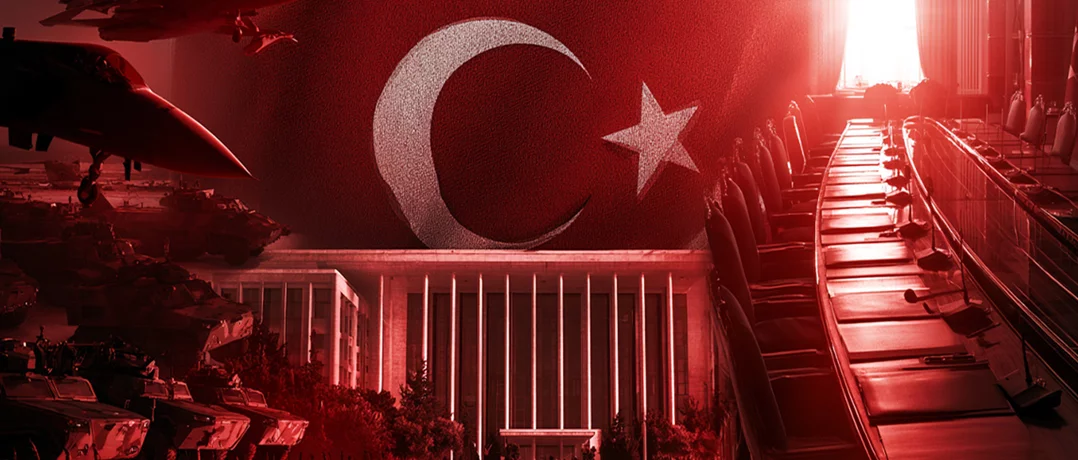
When one thinks of the conflicts reshaping the Middle East, Cyprus is rarely the first place that comes to mind. Yet this time, even the divided Mediterranean island has been pulled into the region’s widening security contest. As the latest confrontation spilled beyond its original theatres, Greece reinforced its military presence around Cyprus, while Türkiye deployed F-16s and air-defense systems to the north.
One might expect such parallel military reinforcement to deepen an already entrenched rivalry. Instead, something seemingly contradictory is happening. Athens and Ankara are preserving a cautious detente, while both have thrown their weight, albeit on very different terms, behind renewed diplomacy over Cyprus.
The contradiction begins to fade once Cyprus is viewed as part of a much wider regional picture. Türkiye’s security concerns in Syria, Iran, the eastern Mediterranean, Greece, and Cyprus are increasingly intersecting, with Israel emerging as a common factor across several of them. For Ankara, the challenge is increasingly how to prevent those separate fronts from becoming one.
From separate files to a single strategic map
For years, Ankara could largely treat the pressures around it as separate strategic files. Syria was dominated by border security, the Kurdish question and Türkiye’s influence in Damascus. Relations with Greece revolved around the Aegean and maritime disputes, while Cyprus remained a largely self-contained conflict over the island’s division.
Iran was a rival to be managed, competing with Türkiye across Syria, Iraq, and the Caucasus without turning that competition into direct confrontation. Israel, meanwhile, was dealt with primarily through Palestine, bilateral relations, and the wider regional balance. Each theatre followed its own logic.
Syria changes the Israeli equation
The old separation began to break down most clearly in Syria. The fall of Bashar al-Assad transformed a theatre in which Türkiye had spent years competing with Iran and Russia into one where Ankara suddenly enjoyed far greater influence, as an HTS-led leadership with longstanding ties to Türkiye took power in Damascus. Assad’s collapse therefore opened the door for Ankara to expand its political, economic and security role across its southern border.
But Türkiye’s expanding influence coincided with a more assertive Israeli presence in Syria. Israeli military operations intensified after Assad’s collapse, bringing Ankara and Jerusalem into increasingly direct strategic proximity. The two countries eventually opened military deconfliction channels to reduce the risk of an unintended clash. For Türkiye, Israel was transforming from a difficult bilateral relationship shaped largely by Gaza and Palestine into an actor operating within Türkiye’s immediate security environment.
When the Iran war reaches Türkiye’s periphery
The war with Iran widened the geography of Türkiye’s growing concern over Israel. What Ankara was already confronting in Syria was no longer confined to its southern border. Iranian ballistic missiles repeatedly entered or approached Turkish airspace, forcing NATO air defenses to intervene and prompting additional protection for Türkiye. Ankara strengthened its defenses while continuing to press Tehran and Washington toward de-escalation.
The significance for Türkiye goes beyond the Iranian threat itself. A confrontation driven by Israel on one side and Iran on the other is now producing security consequences across theatres Ankara had previously managed separately, from its eastern airspace to Cyprus and the Eastern Mediterranean. Israel is increasingly present, directly, or indirectly, at the center of each equation.
The Eastern Mediterranean and the fear of containment
That convergence became even clearer in the Eastern Mediterranean. Greece, Israel, and Cyprus have steadily deepened a relationship that now extends well beyond diplomacy and energy. In December 2025, the three signed a joint military action plan for 2026 that expanded their air and naval exercises, while Athens has since approved a €3.5 billion air-defense system built around Israeli radars and missiles.
For Ankara, the concern lies in how closely the three states are now cooperating, with Israel’s growing role in Syria increasingly intertwined with its expanding military partnership with Greece and Cyprus to Türkiye’s west. Asked in January about the expanding military relationship among Greece, Israel, and Cyprus, Hakan Fidan, Türkiye’s Minister of Foreign Affairs, warned against arrangements that could restrict Ankara’s room for maneuver and described attempts to contain the country as a national-security concern.
That does not mean Athens, Nicosia and Jerusalem necessarily view their partnership primarily as an anti-Turkish bloc. Their cooperation has its own military, economic and energy logic. But for Ankara, intent matters less than strategic effect. Israel is no longer present on one Turkish front, but across several of them. And if those fronts begin to reinforce one another, confronting Greece more aggressively could help create precisely the alignment Türkiye is trying to avoid.
Ankara’s response to this perceived convergence has not been to escalate everywhere at once. Despite deepening military cooperation between Greece, Israel and Cyprus, Türkiye has continued to preserve a cautious detente with Athens. Erdoğan and Mitsotakis used their sixth High-Level Cooperation Council in Ankara in February 2026 to renew the political and military confidence-building framework established in 2023, discuss Cyprus and the Aegean, and explore cooperation over Syria’s reconstruction.
The logic is strategic. Türkiye is unlikely to dismantle Greece’s relationship with Israel, which now carries military, technological and economic value independent of Ankara. But reducing Greek-Turkish tensions can weaken the incentive for Athens to treat Israel primarily as a counterweight to Turkish power.
In that sense, detente serves a defensive purpose of its own. What Türkiye needs is to prevent Greece from becoming a permanent component of a wider strategic alignment against it. Cyprus diplomacy therefore becomes part of the same effort to keep separate rivalries from hardening into a common front.
Cyprus as a test of managed rivalry
Türkiye has made clear that it will protect its military position on Cyprus, even as it has become increasingly willing to explore a diplomatic opening over its political future.
That second track gained momentum in July, when António Guterres became the first serving UN secretary-general to visit Cyprus in sixteen years, meeting both Cypriot leaders and preparing the ground for another 5+1 meeting involving the two communities, Türkiye, Greece, and Britain. Ankara welcomed the process and backed practical confidence-building measures.
Ankara’s engagement should not be mistaken for agreement with the UN’s preferred federal settlement, however, as Türkiye continues to insist on Turkish-Cypriot sovereign equality. The 5+1 format guarantees Ankara a role in any discussion over the island’s future, while diplomacy offers a way to manage a dispute increasingly exposed to the wider regional contest.
Managing convergence
Türkiye’s response to this changing regional map is therefore neither retreat nor simple escalation. Ankara is reinforcing its position where it considers its interests directly threatened, while opening diplomatic space where confrontation could prove strategically counterproductive. Its dialogue with Greece, engagement over Cyprus and deconfliction with Israel in Syria all reflect variations of the same calculation.
Türkiye can manage rivalry with Israel, disagreements with Greece and a divided Cyprus as separate challenges. The real test for Ankara will be whether it can keep regional competition fragmented before geography turns those rivalries into a single strategic constraint.
-
-

-
Nami El KhazenJournalistFocusing on geopolitics and international affairs.
-
