



Iran is facing ongoing protests fueled by economic pressure and a deeper loss of faith in the regime, marking a break from past stability.
What is happening in Iran?

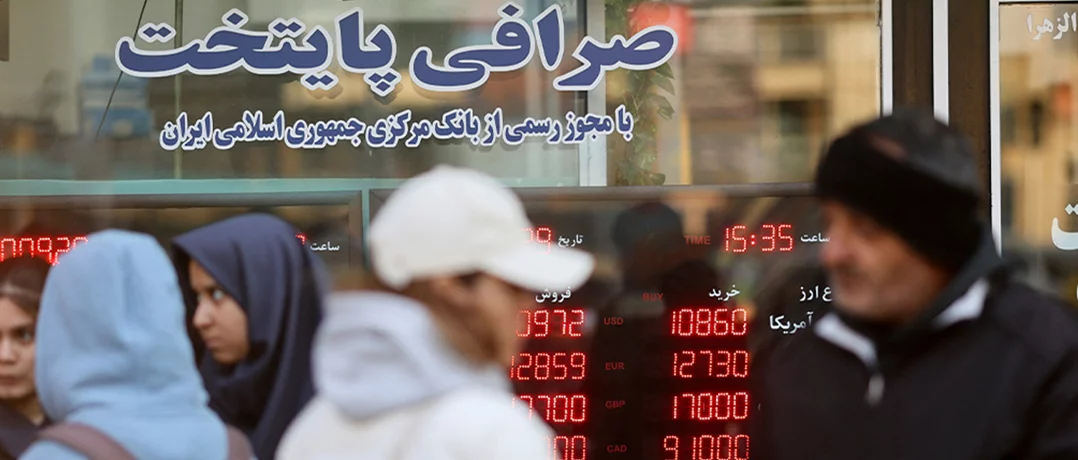
The MTV website presents a brief overview of the background to the popular protest movements taking place in several Iranian cities.
Although the economy is the spark, what is unfolding in Iran is a cumulative crisis of the regime, not merely a temporary wave of anger.
The current economic crisis stems from:
- A rentier-security economy dominated by semi-military institutions (the Revolutionary Guard, the Basij, religious foundations)
- The absence of transparency and accountability
- Repeated failure to manage sanctions through adaptation rather than confrontation
- The depletion of resources on regional policies instead of domestic needs
Accordingly, the street is not protesting solely because prices have risen, but because there is no horizon for improvement.
Historically, the Iranian regime was built on an equation:
Revolutionary legitimacy on the one hand, and social support in exchange for political obedience on the other. This equation has collapsed with the absence of social justice, genuine political representation, the inability to achieve economic recovery, and the erosion of trust in institutions.
The protests reflect a psychological and collective withdrawal from the regime’s legitimacy, even if this is not explicitly declared.
The current protests are not the first, but they are different.
They are leaderless protests, and this is both their strength and their weakness:
- There is no single leader or central organization
- They are difficult to infiltrate or eliminate completely
- Yet they lack a clear political project
For this reason, the regime fears them, but is betting on wearing them down.
Notably, the social composition of the street has changed. Protesters are no longer limited to:
- Students
- Intellectuals
- Minorities
They now also include:
- Bazaar merchants (historically very significant)
- Workers
- Government employees
- A middle class that had been “silent”
The entry of the bazaar and the middle class signifies a strategic shift in the nature of the protests.
After the protests of 2019 and 2022, something has changed: repression no longer deters as it once did, and society has learned that silence does not protect it. Fear has not disappeared, but it is no longer sufficient to silence everyone.
The Iranian Regime’s Dilemma
Today, the regime is trapped between three bad options:
First option: comprehensive repression
It may succeed temporarily, but it increases resentment, widens the gap between state and society, and exhausts the security apparatus itself.
Second option: limited economic reforms
These may provide temporary calm, but they do not address the root of the problem, and the street no longer trusts promises.
Third option: genuine political reform
This could save the regime, but it threatens its ideological structure and opens a door that cannot be closed.
This raises the question: why have the protests not turned into a revolution?
Despite the momentum, there are real obstacles:
- The absence of a clear political alternative
- The strength and organization of the security apparatus
- Fear of chaos or a “Syrian scenario”
- The lack of effective international support for change
So what are the possible scenarios?
Scenario one: security containment accompanied by the exhaustion of protesters.
Scenario two: fractures within the regime through divisions among power factions, sacrificing certain figures and implementing cosmetic reforms.
Scenario three: a long, gradual transformation that does not reach the level of revolution, but is limited to successive waves of protest that, over years, lead to profound change.
In conclusion, Iran today is not on the brink of immediate collapse, but it has entered a phase of no return to its former stability.
It is living a struggle between a strong state without legitimacy and a society that rejects the reality but has not yet found a path to deliverance.
-
-

-
The Beiruter
-
