



Architecture shapes how we experience a home, from light and privacy to nature and spatial design, creating the conditions for comfort and belonging while personal memories ultimately turn a house into a home.
What makes a house feel like home?

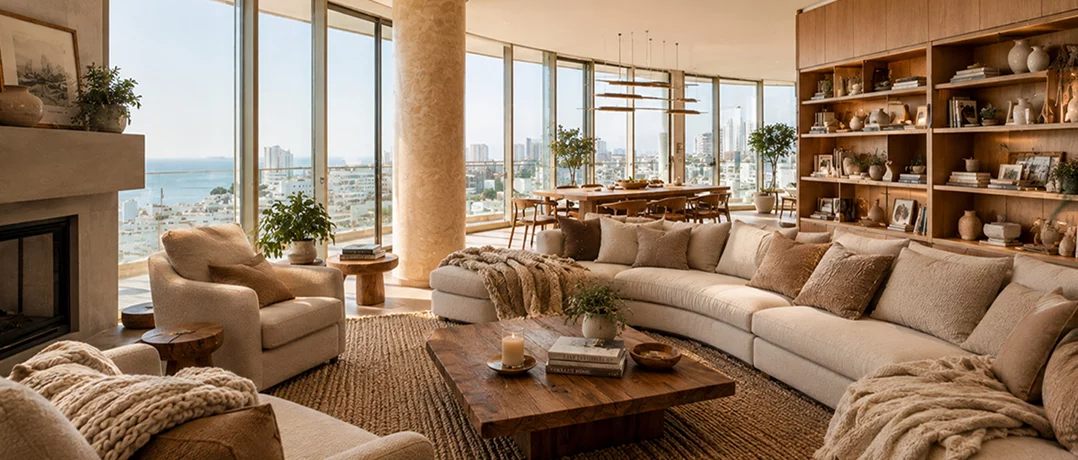
There is a difference between a house and a home, and most people can sense it within seconds of walking through a door, long before they could explain why. Some spaces put the body at ease before the mind even catches up. Others, despite beautiful finishes, never quite settle into comfort. The gap between the two is architecture working on the nervous system, often without anyone noticing. In Lebanon, where homes must also answer to density, heat, noise, and economic pressure, that architecture carries even more weight.
To understand how design shapes the feeling of home, and how psychology explains why, The Beiruter spoke with architect Anthony Boutros.
The architecture of belonging
Asked what actually happens when a house "feels like home," Boutros didn't point to furniture or finishes. "Architecturally, this can come from very simple things, the scale of the rooms, natural light, the warmth and texture of materials, the relationship between private and shared spaces... A successful home doesn't just accommodate your body; it accommodates your life." Central to that, he said, is a sense of control. "You should be able to choose when you want to be together with others and when you want to withdraw."
Environmental psychology backs this up directly. Research consistently shows that physical surroundings are not neutral backdrops but active participants in shaping mood and cognition, the brain processes light, scale, and material below conscious awareness, continuously and automatically. Boutros described how ceiling height and proportion tap into this. "Very high ceilings can create openness and a sense of freedom, while lower or more intimate spaces can create warmth and security. Neither is automatically better; it depends on the purpose of the room." This mirrors what researchers call the "cathedral effect", documented studies on ceiling height and perceived enclosure show taller ceilings prime the brain toward abstract, expansive thinking, while lower ceilings favor focus and intimacy.
Privacy without isolation
Lebanese homes, Boutros explained, must resolve a particular tension, a culture built around gathering, layered onto a need for personal retreat. "Privacy is particularly interesting in Lebanon because our culture is very social and family-oriented... but at the same time everyone still needs personal space." His solution isn't walls, but sequence. "There can be a gradual transition from the entrance to the reception or living areas and then toward bedrooms and more private spaces." Crucially, he added, "Good privacy is not isolation. It is having control over how much of yourself and your home you choose to reveal."
Balconies, light, and the pull toward nature
Few elements matter more to Boutros than the threshold spaces, balconies, terraces, windows, that blur the line between inside and out. "A balcony is technically part of your home, but emotionally it sits somewhere between private and public. You can step outside, feel the air, see the sky... without actually leaving your home." He described windows not as mere openings but as active design elements, "A window should not be treated merely as an opening in a wall. It is a frame that captures the beauty of the surroundings."
This instinct has a name in psychology: biophilia, humans' innate affinity for the natural world. A growing body of research links views of nature and access to daylight with reduced stress, improved mood, and even faster physical recovery, while natural materials like wood and stone produce different psychological responses than synthetic equivalents, even when they look similar. Boutros sees this as something Lebanon is uniquely positioned to offer. "We have mountains, the Mediterranean, valleys and greenery. As architects, we should take advantage of that... This connection becomes even more important today because we spend so much of our lives indoors and in front of screens."
Designing for Lebanon's realities
None of this happens in a vacuum. "In Lebanon, designing a home cannot be separated from the realities people live with," Boutros said, citing shrinking apartment sizes, electricity shortages, and urban noise as forces now shaping architecture directly. His solutions are practical, deep balconies for shade and acoustic buffering, cross-ventilation to offset power cuts, double glazing against noise, flexible layouts to stretch smaller footprints. "A deep balcony facing a busy street can act as a buffer, it provides shade, improves privacy, reduces the impact of noise and at the same time creates a connection between the interior and the outdoors."
Where architecture ends and memory begins
Asked whether architecture alone can create emotional attachment, Boutros resisted a simple answer. "Architecture can create the conditions for attachment, but it cannot manufacture memories... We can create the balcony where someone drinks coffee every morning, the window where a child sits and looks outside. But we cannot design the conversations, celebrations, arguments, relationships and memories that eventually give those spaces meaning." Over time, he said, inhabitants complete the design themselves. "They add photographs, objects, furniture, plants and traces of their own lives. At that point, the architecture becomes intertwined with personal experience. Perhaps that is where a house truly becomes a home."
A stage for experiences
What emerges from Boutros's account, reinforced by the psychological research behind it, is a picture of home as collaboration between light and shadow, enclosure and openness, structure and improvisation. Architecture cannot force belonging, but it can make room for it, a well-placed window, a balcony that catches the evening air, a threshold that lets someone choose exactly how much of themselves to reveal. "Architecture creates the stage," Boutros said, "but people give that stage a story."
-
-

-
Jenna GeageaReporter/Writer
-
