



In an interview with The Beiruter, geologist Dr. Tony Nemer explains whether underground explosions in southern Lebanon can trigger earthquakes and what current scientific evidence reveals.
What science says about seismic risks in southern Lebanon
What science says about seismic risks in southern Lebanon
By The Beiruter | July 25, 2026

Reading time: 6 min
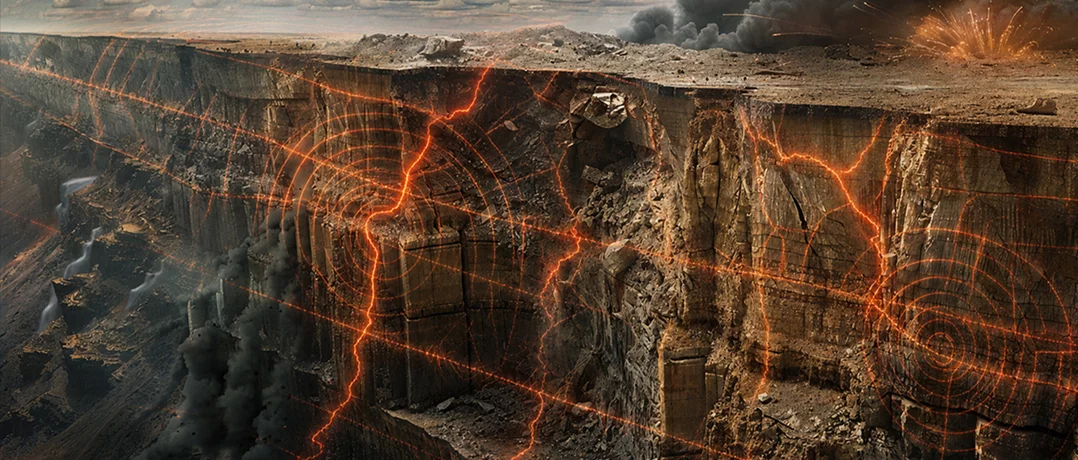
The extensive use of underground explosives in conflict zones often raises questions about their potential geological impact, including whether large-scale tunnel detonations can produce earthquake-like shaking, destabilize faults, or trigger seismic activity.
These concerns have gained particular attention in southern Lebanon, where repeated underground explosions have fueled public debate.
To better understand the science behind these issues, The Beiruter spoke with Professor of structural geology, earthquake geology, and active tectonics, Dr. Tony Nemer.
What has been observed in southern Lebanon?
Although the theoretical possibility exists, current observations from Lebanon remain scientifically reassuring.
Dr. Nemer stated that seismologists have not observed sustained increases in local seismic activity following the major underground explosions that have occurred to date. While earthquakes generated directly by the explosions themselves occurred immediately afterward, as expected from the release of explosive energy, there has been no evidence of prolonged or delayed seismic sequences that would indicate widespread fault activation.
He attributed this largely to geography. According to Dr. Nemer, 2 of the 3 largest underground detonations occurred at sufficient distances from Lebanon’s principal active faults, limiting their ability to significantly alter regional stress conditions. The October 2024 explosion in Odaisseh represented the closest event to a major fault system. It occurred near the western branch of the Houla Basin fault system, where the Roum and Yammouneh faults diverge. Despite this proximity, monitoring data fortunately did not reveal significant post-explosion seismic activity beyond the immediate event itself.
Luckily, we did not observe a change in seismic activity after the fact.
Nevertheless, Dr. Nemer stressed that proximity to active faults remains an important consideration for any future underground detonations. He pointed to the reported tunnel complex beneath Beaufort Castle as an area deserving particular scientific attention because of its location near the Roum Fault, one of Lebanon’s most significant active strike-slip fault systems. Operations conducted extremely close to such faults could increase the possibility of localized induced seismicity during or shortly after an explosion, although predicting whether this would actually occur remains scientifically impossible.
Any such military operation on the Roum Fault could cause some induced seismicity.
For this reason, Dr. Nemer stressed that, from a geological perspective, any activities involving major underground explosions should avoid active fault zones whenever possible.
Why underground explosions produce ground shaking
According to Dr. Nemer, the detonation of extensive underground infrastructure in southern Lebanon has undeniably generated noticeable ground shaking.
He explained that residents on both sides of the border experienced these vibrations, with one particularly large explosion on 26 October 2024 producing seismic signals strong enough to activate earthquake early-warning systems in Israel. Such observations reveal that powerful underground explosions can generate seismic waves capable of traveling significant distances through the Earth’s crust.
However, despite the similarities in what people may feel at the surface, explosions and natural earthquakes originate through fundamentally different physical processes.
Natural earthquakes occur when accumulated tectonic stress along geological faults exceeds the strength of surrounding rocks, causing a sudden rupture that releases stored elastic energy. This rupture propagates along the fault, producing a complex combination of seismic waves that radiate outward.
Underground explosions, by contrast, release energy almost instantaneously from a single point through rapid expansion of gases. Rather than resulting from fault movement, the seismic waves originate from an outward pressure pulse generated by the explosion itself.
As Dr. Nemer noted, although both events generate seismic waves detectable by monitoring stations, their wave characteristics differ sufficiently for seismologists to distinguish explosions from earthquakes through waveform analysis. Earthquakes typically produce stronger shear (S) waves because of fault displacement, whereas explosions generate proportionally stronger compressional (P) waves due to the sudden outward release of pressure.
Can explosions influence geological faults?
One of the most important scientific questions is whether repeated or large underground explosions can affect nearby geological faults. According to Dr. Nemer, the answer is scientifically affirmative, but with important qualifications.
Underground explosions alter the stress distribution within surrounding rocks by rapidly increasing pressure in the subsurface. When an explosion occurs close to an active fault, these stress changes can modify the forces already acting on the fault.
This is a major factor in activating a fault or making it move, which actually generates earthquakes.
If a fault is already critically stressed, he cautioned, meaning it is close to failure, even relatively small additional stress changes may contribute to fault movement. This phenomenon is known in seismology as induced seismicity, where human activities influence the timing or occurrence of seismic events without creating the tectonic forces themselves.
Dr. Nemer explained that explosions near active faults therefore represent a potential triggering mechanism rather than a direct cause of tectonic earthquakes. The explosion does not generate the tectonic stress responsible for earthquake formation. Instead, it may slightly modify the existing stress field enough to facilitate movement on an already unstable fault.
The likelihood of this occurring depends primarily on the fault’s pre-existing stress state, the magnitude of the explosion, the geological properties of surrounding rocks, and the distance separating the explosion from the fault.
How do seismologists assess geological impact?
Evaluating whether an explosion has altered the surrounding geological environment requires multiple lines of scientific evidence.
According to Dr. Nemer, one of the first indicators involves direct observation of changes at the Earth’s surface. Large underground explosions can produce dramatic geomorphological modifications, including ground subsidence, surface fractures, crater formation, or localized depressions. He noted that footage from the October 2024 explosions clearly demonstrated substantial surface deformation. Similarly, a recent explosion in Majdal Zoun reportedly created such extensive ground collapse that eyewitnesses described the formation of a depression resembling a small valley that effectively divided part of the town into 2 sections.
Beyond visible surface changes, seismologists carefully compare seismic activity before and after an explosion. This involves determining whether earthquake frequency, magnitude, or spatial distribution differs significantly from the area’s normal background seismicity. If no measurable deviation from historical seismic patterns is detected, scientists generally conclude that the explosion did not substantially alter regional seismic behavior.
Nevertheless, assessing stress changes within faults presents a greater scientific challenge. As Dr. Nemer explained, modern geoscience still lacks the capability to directly measure stress conditions deep inside active faults. Instead, researchers rely on indirect methods, including seismic monitoring, geodetic measurements, numerical modelling, and geological observations, to infer how stresses may have evolved following large underground explosions.
Therefore, current scientific evidence indicates that powerful underground explosions are fully capable of producing perceptible ground shaking and generating measurable seismic waves over considerable distances. However, these events differ fundamentally from natural tectonic earthquakes in both their origin and seismic characteristics.
-
-

-
The Beiruter
-
