


AI deepfakes, algorithmic feeds and repeated unverified claims are making political misinformation in Lebanon faster, more convincing and harder to contain.
When Lebanese politics goes fake

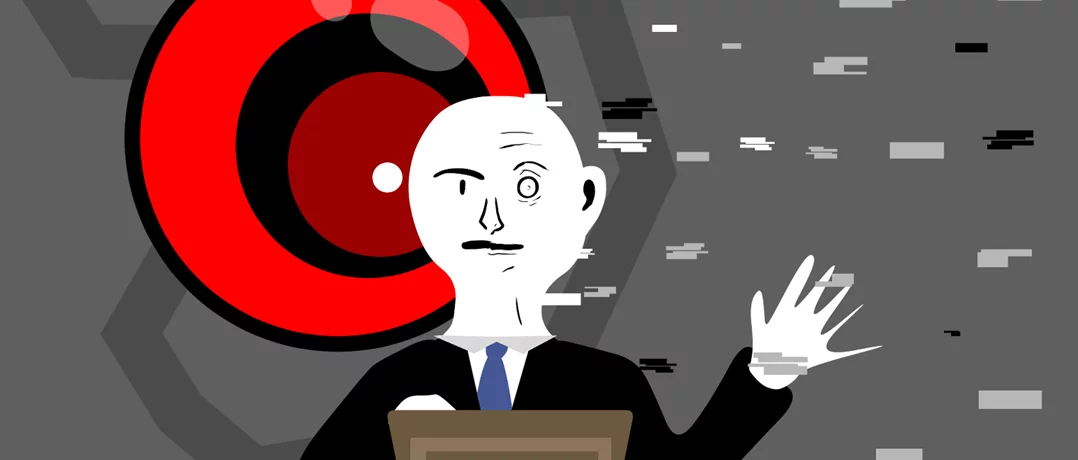
Illustration by Karim Dagher
Political misinformation in Lebanon is becoming harder to spot. A false political claim can now arrive as a TikTok video, an Instagram post or even a convincing clip of a politician saying words they never actually said. And by the time it is checked, it may already have travelled across thousands of screens.
When the News finds you
For many young Lebanese, political news is no longer something they sit down to watch at a fixed hour. It appears between Instagram stories, TikTok videos, WhatsApp messages and the rest of the content on their phones. The news no longer has to be searched for. “I think that the news looks for us!” one participant told a 2025 study commissioned by the Samir Kassir Foundation and conducted by Ipsos.
Among participants aged 18 to 24, Instagram was identified as main news source, with news increasingly “finding them” through algorithmic feeds. The report describes this as a shift toward passive discovery, as young users encounter political and security news while scrolling through Instagram and TikTok rather than actively looking for it. This means that serious political information is increasingly appearing alongside entertainment, influencers and everyday content.
This creates another problem: the platforms themselves decide much of what users see. A September 2025 report by Maharat Foundation warned that social media can amplify false information, inflammatory content, political propaganda and polarization. Its research on Lebanon’s electoral environment also pointed to the use of fake news, hate speech and covert political advertising online.
There are also gaps in Lebanon’s rules. The electoral framework does not fully regulate online campaigning and digital political advertising, while artificial intelligence is creating new challenges that existing laws were not designed to address. This matters even more as political content becomes easier to create, alter and distribute at speed.
When politicians say things they never said
One of the clearest examples came in 2026, when videos began circulating that appeared to show President Joseph Aoun making statements he had never made.
In one video, Aoun appeared to tell Hezbollah supporters that anyone who wanted to defend Iran should go there. An-Nahar’s fact-checking team found that the statement was fabricated. The video had been posted by an account known for AI-generated political content, and a technical check using Hive Moderation indicated a very high probability that AI or deepfake technology had been used.
Another video later appeared to show Aoun accusing Parliament Speaker Nabih Berri of blocking solutions to Lebanon’s crisis and discussing negotiations with Israel. Again, the words were not his. An-Nahar traced the footage back to a real meeting involving the president, but found that the original material had been manipulated to make him appear to say something different.
These cases show how political misinformation is changing. A false claim no longer has to appear as a written quote or anonymous post. Users can now watch what looks like a real president, in a real setting, apparently delivering words that were never spoken.
Can fact-checkers catch up?
False political content can also become more believable simply by being repeated. An April 2026 report by SKeyes and InflueAnswers followed two unverified narratives after Israeli strikes on Lebanon. One claimed Hezbollah officials had been located through a Zoom meeting and tracked through their IP addresses. Another claimed the strikes had prevented an attempt by Hezbollah to seize state institutions.
The researchers documented 52 instances in which the narratives moved through social media, WhatsApp, television, political commentary and regional media. The report did not try to prove whether the original allegations were true or false. Instead, it showed how claims with unclear or weak sourcing can circulate between different platforms until repetition begins to give them greater credibility.
Lebanon has begun creating more formal ways to respond. In March 2026, the Ministry of Information and UNESCO launched Fact Check Lebanon, a dedicated fact-checking unit designed to monitor circulating claims, verify information and publish findings. Staff also received training in digital verification tools and methods for tracking misinformation across platforms.
Young journalists are also being trained to recognize the problem earlier. A UNDP programme with Dawaer trained 50 Lebanese media students in 2025 to identify misinformation and understand how false content is created and amplified online. Participants were also taught how algorithms can reward emotional or provocative material and how to produce more responsible digital content. The wider programme has since trained more than 180 students across Lebanon.
Lebanon now has more fact-checkers, verification projects and media-literacy initiatives than before. But political information is also becoming faster and easier to manipulate. So, can a false political story be checked before enough people have already seen, believed and shared it?
-
-

-
Natalie DurhamResearcher/Writer
Junior research writer focusing on politics, public policy and international affairs.
-
