



Chronic stress can make exhaustion and constant alertness feel normal, masking the physical and emotional toll of daily uncertainty in Lebanon and beyond.
When stress becomes your normal

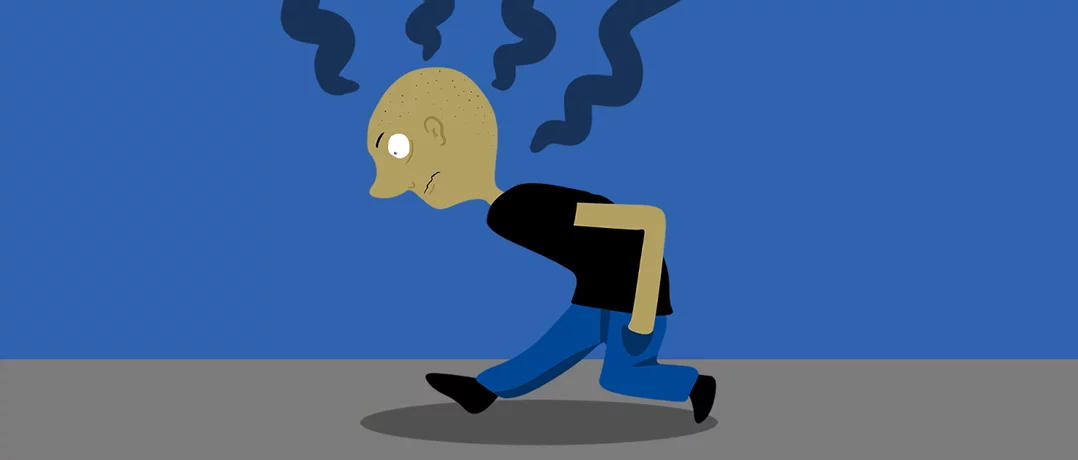
Illustration by Karim Dagher
Every Lebanese person knows this moment. The generator cuts off. A phone buzzes with breaking news. A car backfires on the street. And the body barely reacts. The heart beats faster for a second, then calms down, not because the danger is small, but because the body stopped counting it as danger a long time ago.
This is what happens when stress stops being something that happens to you, and becomes the air you breathe every day.
The body remembers, even when the mind stops noticing.
A client of mine, a woman in her thirties, once sat across from me and described her week without pausing for breath. Work, traffic, her mother's health, a husband who worked late, a toddler who barely slept. When she finished, I asked her how she was doing with all of it. She looked confused by the question. "This is just life," she said. "Everyone is tired." It took a few more sessions before she noticed she hadn't slept properly in months, that her jaw ached from clenching it all day, that she flinched at her own phone ringing. None of it had registered as stress. It had just registered as Tuesday.
In a country that has lived through war, collapse, and daily uncertainty, people often say some version of the same thing: "I'm used to it." It sounds strong, and sometimes it is. But often it means something else entirely. It means the body has quietly changed what it calls normal, and stopped sending the warning signs that used to say something is wrong.
Chronic stress rarely looks like fear. Most of the time, it looks like getting through the day. Getting the kids to school. Going to work. Making jokes about the power cuts. From the outside, it looks like coping. Inside, though, the body is still on alert. It never fully rests. Sleep gets lighter. Patience gets shorter. None of it feels like a problem, because there is no single bad moment to point to, and no "before" left to compare it with.
A single scary event has a clear start and a clear end. You can name the day the war began, the night something exploded, the week money lost its value. Chronic stress doesn't work that way. It builds slowly, day after day, until it simply becomes how things are. Most people never notice how heavy it has gotten, because it never arrived all at once.
It is not only about war
This is not only about Lebanon, and not only about war. The same pattern shows up in a marriage that has quietly turned cold and tense. It shows up in a job where you feel your stomach tighten before you even open your email. It shows up in a home where one person's mood decides whether the day will be calm or hard, and everyone else has learned to read the room before anyone says a word.
These are inner wars. No sirens, no borders. But the same body, reacting the same way. The nervous system that learns to survive a bombing can also learn to survive a home where love comes with conditions, or a life where staying quiet feels safer than speaking up. The danger looks different. What happens inside the body does not.
This is why someone who never lived through an actual war can still feel every word of this article. Chronic stress doesn't need a dramatic event. It just needs something hard to keep happening, again and again, for long enough, until the mind adjusts to whatever keeps repeating. That's not weakness, it's how humans survive. But it comes at a price. Once the body adjusts to something hard, it stops treating it as hard at all.
What it costs to call it normal? The real danger of chronic stress isn't the stress itself. It's what happens once we stop calling it stress. Once something becomes "just how life is", we stop looking for a way out, simply because we no longer notice we're stuck in something at all.
Like my client, most people carry the signs without naming them. Trouble sitting still, a quiet unease that never fully lifts. Waking up tired even after a full night's sleep. Getting irritated by small things that shouldn't matter this much. Feeling uneasy during calm moments, almost waiting for something to go wrong. None of this is a personality flaw. It's a body that has been working too hard for too long, and has forgotten what it feels like to truly rest.
For children, this matters even more. Growing up around constant tension teaches a child what to expect from the world before they even have the words for it. A child raised in a tense home, or in a country that never feels stable, doesn't need anyone to tell them the world can be unpredictable. Their body already knows. That early lesson shapes how they see relationships, risk, and safety for the rest of their life.
Naming it is the first step out. Getting better doesn't start with fixing the war outside, the tension at home, or the struggle inside your own mind, all at once. It starts smaller than that. Noticing what has quietly become your normal. Realizing that "I'm used to it" is not the same as "I'm okay," and that a body which has stopped reacting hasn't necessarily healed. Sometimes it has simply run out of energy to react at all.
My client didn't need to fix her marriage, her mother's health, or her sleepless toddler in one week. She needed to notice, first, that she had stopped counting any of it as hard.
Stress becoming your normal doesn't mean you handled things well. It means you survived them, and those aren't the same thing. Knowing the difference is where real healing begins.
-
-

-
Joyline EidWriterClinical Psychologist.
-
