



Iran’s adaptation to sanctions is reshaping regional stability and oil markets, the IIF finds.
Why sanctions have failed to destabilize the Iranian regime
Why sanctions have failed to destabilize the Iranian regime
By The Beiruter | December 18, 2025

Reading time: 4 min
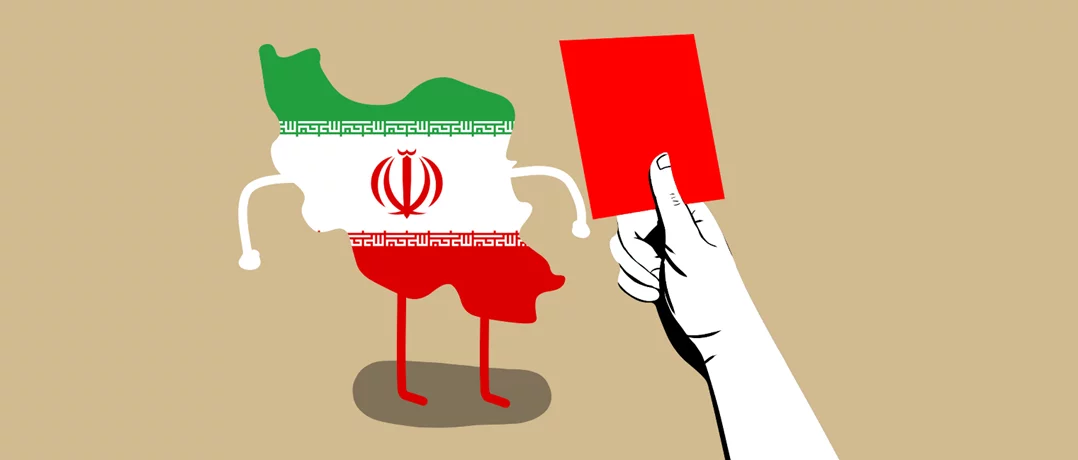
Illustration: Karim Dagher
The Institute of International Finance (IIF) has released a detailed report examining the impact of economic sanctions on Iran and the reasons these measures have lost some of their effectiveness in delivering the anticipated political outcomes. The report, prepared by the institute’s chief economist for the Middle East and North Africa, Garbis Iradian, also addresses the repercussions of Iranian policy on Lebanon.
Nuclear negotiations between Iran and the United States remain stalled. Iran continues to insist on its right to enrich uranium domestically and rejects any broader talks on missiles or regional activities. The United States, for its part, has maintained sanctions, but their enforcement remains incomplete. This deadlock carries far-reaching economic, political, and strategic consequences.
Why sanctions have failed to destabilize the Iranian regime
Iran’s economy has been subject to various forms of sanctions since the 1979 revolution, with particularly stringent Western measures over the past eight years targeting energy exports, the banking sector, and military capabilities. These restrictions have curbed growth and reduced economic potential. Yet the economy has continued to function, and the regime has endured, reflecting a tightly controlled security apparatus led by the Islamic Revolutionary Guard Corps and intelligence services that dominate key sectors and suppress opposition. Economic hardship has disproportionately affected society, while the regime has exploited an extensive sanctions-evasion infrastructure, including informal oil fleets, barter trade, and non-dollar payment systems, alongside a large domestic industrial base and a population accustomed to inflation and rationing.
Despite sanctions, Iran is not geopolitically isolated. China remains its main oil buyer, while Russia provides military and diplomatic support. These relationships mitigate the impact of Western measures, which have not been applied consistently, allowing Iran to exploit loopholes and reinforce its self-sufficiency strategy. Nonetheless, mounting macroeconomic pressures, such as high inflation, currency depreciation, and fiscal deficits, are straining Iran’s social fabric and weakening elite cohesion.
Economic outlook
Without a resumption of talks or sanctions relief, Iran’s economy will remain constrained by isolation, high inflation, and weak investment. Real GDP growth is expected to remain subdued at around 1% in 2025–2026, while the divergence between official and parallel exchange rates continues to widen, reaching 65% in recent weeks. Annual inflation rose to 50% in October 2025, and the fiscal deficit is expected to expand to around 6% of GDP this year.
Iran exports between 1.3 and 1.5 million barrels per day, mostly to China, through black-market channels, where payments in yuan or barter provide limited but vital foreign-currency inflows. Politically, hardliners are expected to dominate, even as social and financial pressures intensify.
Oil exports to China
Iranian oil continues to reach China despite sanctions for several reasons:
Shipments are disguised as Malaysian or Omani crude through ship-to-ship transfers.
Payments are made in yuan or via barter through small banks with no ties to the United States.
The United States applies sanctions selectively to avoid driving up oil prices.
Complex shell companies and oil tankers registered under multiple flags make full enforcement impractical.
This implicit arrangement benefits all parties: Iran earns foreign currency, China secures discounted oil, and the United States avoids global price shocks.
Why China remains hesitant to invest in Iran
China has a 25-year cooperation agreement with Iran and has increased its purchases of Iranian oil. However, it continues to avoid direct investment for several reasons, including:
The risk of secondary U.S. sanctions on globally active Chinese companies;
Dysfunctional banking channels and opaque payment systems in Iran;
Weak investment protection and the dominance of the Revolutionary Guard over key sectors;
A desire to balance relations with Gulf Cooperation Council states and maintain neutrality.
Implications of the U.S.–Iran nuclear stalemate
The prolonged deadlock in U.S.–Iran nuclear negotiations reinforced by renewed sanctions, findings by the International Atomic Energy Agency on Iran’s non-compliance, and ongoing regional tensions, has created a structural geopolitical environment with uneven effects across the Middle East and North Africa.
The extended impasse, under persistent sanctions, limits Iran’s ability to increase officially recognized oil exports.
For Gulf Cooperation Council states, this means Brent crude prices are unlikely to collapse even amid weak global demand, as Iranian supply remains constrained and unofficial flows are inefficient and costly. While moderate oil prices around $60 per barrel may support the external balances of low-cost producers such as the United Arab Emirates, Qatar, and Oman, they remain well below Saudi Arabia’s fiscal breakeven, reinforcing the need for continued fiscal discipline, reprioritization of strategic spending, and diversification under national transformation programs.
Geopolitical stalemate also sustains a modest risk premium on regional shipping routes, occasionally raising insurance and transport costs, though not to levels that fundamentally alter trade flows or investment plans in the Gulf.
Strategically, the impasse heightens regional security concerns, compelling GCC states to maintain high defense spending and deepen cooperation with the United States, while simultaneously hedging diplomatically by strengthening ties with China, India, and Europe. GCC countries must balance their oil market share, strategic relations with Washington, and rising fiscal deficits.
Iran’s declining influence in Iraq has reduced the operational capacity of its proxies, easing pressure on Iraqi sovereignty. While these groups still pose local risks, reduced funding and influence have lowered the likelihood of widespread instability.
Politically, Baghdad remains caught between U.S. and Iranian interests, complicating reform efforts. Iraq benefits marginally from stable oil prices, but sanctions on Iran restrict cross-border energy cooperation and trade, limiting its potential as a regional energy hub.
Impact on Lebanon
For Lebanon, the repercussions are highly negative. Iran exploits Hezbollah’s armed status as a strategic lever in its negotiations with the United States over the nuclear deal, continuing to provide the group with military, financial, and political support. As a result, Hezbollah refuses to disarm or integrate into the Lebanese Armed Forces, maintaining dual sovereignty and preventing the formation of a coherent national security policy. This prolonged stalemate increases Lebanon’s exposure to Israeli escalation along the border, sustaining elevated sovereign risk and deterring investment, tourism, and donor financing.
Significant economic potential
Despite ongoing macroeconomic pressures and institutional constraints, Iran’s long-term economic potential remains considerable. In theory, a sanctions-free environment, though unlikely, could unlock opportunities to resume global trade and fully develop the country’s vast energy resources. With a population of 88 million, substantial oil and gas reserves, a relatively diversified economy, and a well-educated workforce, Iran possesses many foundations for sustainable growth. Unlike most regional oil exporters, Iran has a large-scale industrial sector.
However, Iran’s energy sector requires substantial foreign direct investment and advanced technologies to realize its potential as a global energy leader. Market-based reforms aimed at improving efficiency and competitiveness could strengthen private-sector-led growth. Yet the private sector accounts for only 40% of GDP, with the remainder dominated by public institutions and a “quasi-private” sector controlled by the Revolutionary Guard entities that are central to regime resilience but inherently less secure.
-
-

-
The Beiruter
-
