



On a Wednesday night, Emma Gration and Hoedy Saad turned their history of arguments into a theatrical drag battle filled with humor, chaos and tenderness, while opening a conversation about what it takes to create queer art in Lebanon.
‘Mortal Banat’ turns drag drama into a fight for community
‘Mortal Banat’ turns drag drama into a fight for community
By Rayanne Tawil | August 23, 2026

Reading time: 5 min
There was no need for a referee. Tom and Jerry had already started the fight.
Their familiar cartoon chaos played over the speakers as the room settled in, setting up what was about to become a very drag version of a battle.
Emma Gration entered to “What Doesn’t Kill You Makes You Stronger,” one arm deliberately hanging as if dislocated. Hoedy Saad followed with a walker, each prop offering a ridiculous preview of the “aftermath” of their supposed fight.
Then came “Mortal Banat,” a theatrical parody of “Mortal Kombat,” complete with exaggerated poses, choreography, and enough drama to make their X (formerly Twitter) history feel like part of the script.
Emma eventually “shot” Hoedy as a joke.
The two then faced each other with screenshots of their previous online fights, alongside AI-generated images that turned their old drama into something bordering on cartoonish.
It was funny because the history was real.
“We've had our ups and downs,” Emma told The Beiruter. “There's a lot of drag drama that used to happen back in the day. There's this perception of us being mortal enemies. But at the end of the day, there's a lot of love.”
That tension gave the show its shape. Emma and Hoedy have argued, thrown shade and misunderstood each other. They have also remained friends. As Emma explained, “When we used to meet at gatherings and parties, we would just hug and start laughing. So it was never, I hate you.”
The joke opens the door
The performance kept moving between absurdity and something more vulnerable.
Emma brought audience members into the show, helping them work through relationship conflicts in a deliberately ridiculous, comedic way. Hoedy appeared dressed as a carrot, using the costume as a way to turn a traumatic experience into a joke. The audience laughed, cheered and played along.
That is where the show became more than a staged fight.
For a community that often has to think about visibility, safety and who is watching, humor becomes a way to say difficult things without losing the joy that brought everyone into the room.
Emma described drag as an outlet for that freedom. “It does give you this outlet where you can express yourself, you're free,” she said. “It does give you a very big dose of confidence.”
Hoedy spoke from a different angle, describing drag as an extension of his artistic identity. “My drag is just like a translation of my artistic vision, but still the same person,” he told The Beiruter. “I don't play a character.”
The distinction matters in a scene where performers are often reduced to their costumes, makeup or stage personas. What the audience sees for a few minutes can represent countless hours of preparation.
“It takes weeks and months sometimes to create what they see on stage,” Hoedy said. “That three or five minutes on stage sometimes takes literally weeks to create from the outfit to the concept, to the music, to the choreography.”
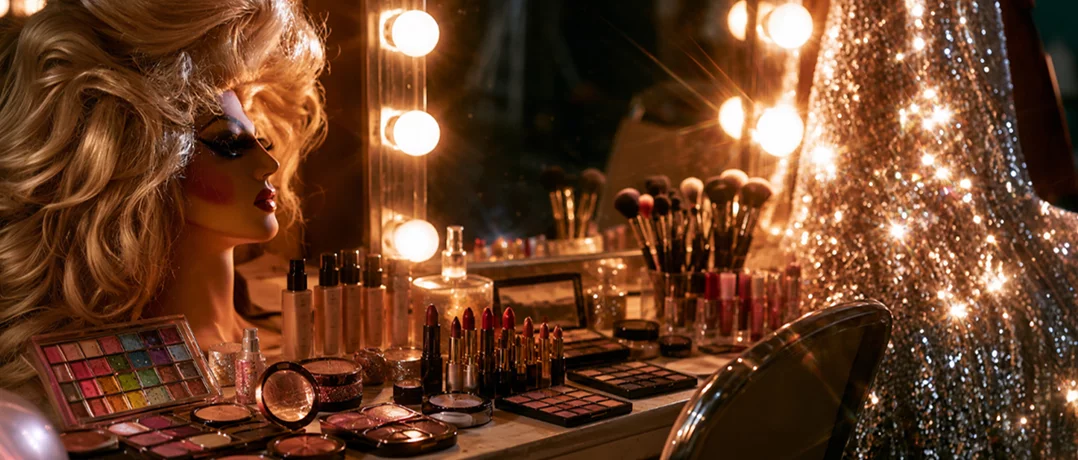
What the audience doesn't see
The glamour also comes with practical and personal risks.
Emma described changing in kitchens because some venues have no backstage or artist room. “They don't see the panic. The running around. The sweating,” she said. “But what I love about it is that we find ways to get on stage and make it work.”
There is also the question of safety.
Emma explained that performers have developed unspoken boundaries around what they can say and show, particularly because videos can travel outside the room and strip a joke of its context. “We truly aren't doing anything that harms anyone,” she said. “It's just like watching theater. It's just for people to come, escape for a while, have some fun, have some drinks, and just, you know, have a good time.”
Hoedy described the challenge more directly: “I do believe maybe it's just like keeping it more underground, the lack of visibility nowadays, and it's all for safety reasons, you know, to protect the venues, the crowd and ourselves.”
That reality hangs over the celebration. Drag can be loud, glamorous and deliberately outrageous onstage while the people creating it still have to consider who might photograph them, where the performance is happening and what happens after the show.
Staying together
Emma traced the growth of Beirut's contemporary drag scene to around 2013 and 2014, when traditional drag shows began attracting audiences alongside the growing global popularity of “RuPaul's Drag Race.” The scene expanded, then faced COVID, economic hardship and the 2023 attack Emma described as a major setback.
“There are a lot of people who come to watch us that aren't necessarily out of the closet,” Emma said. “The attack had a lot of media coverage. Also, people were scared. If I watch a drag show, I don't want to be outed.”
The response has been to keep performing while adapting to the circumstances.
Hoedy sees that solidarity as essential. “No matter how much we fight, we have our differences, we still love and respect each other,” he said. “And this is what's needed in the community, you know, in our community especially.”
For Emma, that became the message she wanted “Mortal Banat” to leave behind: “After all is said and done there's a lot of love within the community. There might be ups and downs, there might be shade or there might be fights, but at the end of the day there is love.”
The show ended with Emma and Hoedy speaking directly to the audience and raising awareness about issues facing the community, emphasizing on the need to support one another, before taking selfies together. The performers who had spent the night pretending to destroy each other stood surrounded by the people who had laughed with them, cameras raised. And the final battle ended in a room full of selfies.
-
-
-
Rayanne TawilCultural writer
-
