President Joseph Aoun's back-to-back visits to Washington and Ankara reveal a shifting regional landscape in which the United States, Turkey, Israel, Syria, and Hezbollah are redefining the balance of power—and Lebanon's place within it.




President Joseph Aoun's back-to-back visits to Washington and Ankara reveal a shifting regional landscape in which the United States, Turkey, Israel, Syria, and Hezbollah are redefining the balance of power—and Lebanon's place within it.

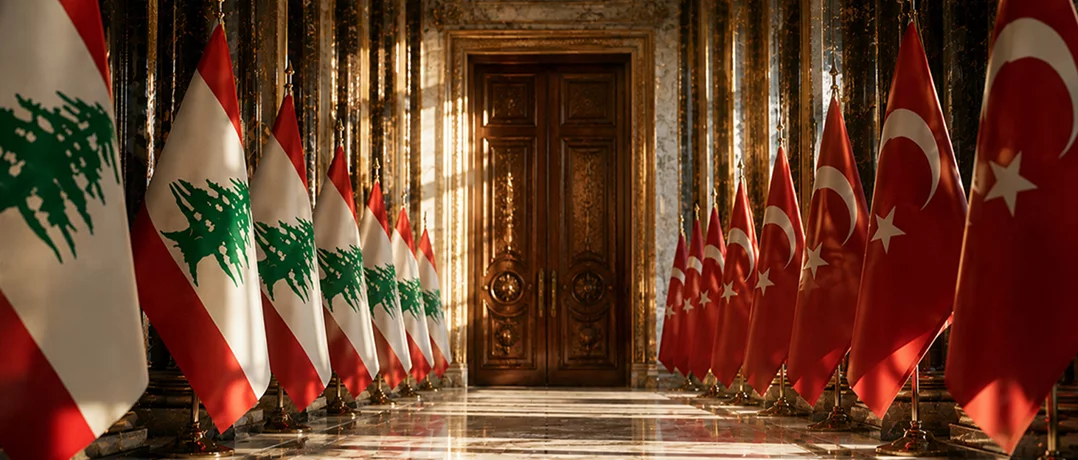
On July 21, President Joseph Aoun entered the White House. Nine days later, he was received in Ankara by Erdoğan. In Lebanon, we have a habit of treating diplomatic visits as isolated photographs: a handshake, two flags, a joint statement, and phrases about historic relations. Then we move on. But presidents do not travel in sequences by accident. Diplomacy has geography, and the order of visits often reveals the order of strategy. Washington first. Ankara second.
Aoun went to Washington carrying the heaviest files of the Lebanese state: Israeli withdrawal, Hezbollah’s weapons, support for the army, reconstruction, economic recovery and sovereignty. It was the first White House visit by a Lebanese president in nearly two decades. Trump reduced the matter, in his usual way, to its most marketable sentence: Lebanon had been badly treated, and there was “a Hezbollah problem.” Behind the language was a transaction. Lebanon would attempt to recover the state; Washington would attempt to produce Israeli withdrawal and international support.
This is how Donald Trump understands foreign policy. He is less interested in solving the Middle East than in finding openings inside its failures. Where previous American administrations arrived with doctrines, road maps and beautifully designed disasters, Trump arrives looking for leverage. He does not ask whether a conflict can be resolved in a final and philosophically satisfying way. He asks what can be extracted from the moment, who needs what, and what arrangement can be sold as movement.
Iran is weakened: opportunity. Hezbollah has lost room to manoeuvre: opportunity. Syria has changed: opportunity. Turkey has become indispensable: opportunity. Lebanon, after years of paralysis, has a president and government willing to test previously impossible options: another opportunity. Opportunities are not institutions, and deals are not regional orders. A signature can suspend a conflict without resolving what produced it. But Trump understands that people often prefer an incomplete opening to a complete dead end. He finds the opening and leaves the architecture to those who remain. That is where Ankara enters.
Aoun’s visit to Turkey was not a ceremonial addition to Washington. It was the regional continuation of it. In Ankara, Erdoğan offered support for Lebanon’s recovery and armed forces, encouraged stronger relations between Beirut and Damascus, and announced Turkey’s interest in participating in whatever security arrangement follows the end of UNIFIL’s mandate. Aoun described Turkey’s role as complementary to American and international support, not an alternative.
That distinction matters. Lebanon is not simply moving away from one capital and toward another. It is being repositioned within a new network in which Washington provides international cover, Ankara provides regional reach, and Syria becomes the geographic bridge. Turkey occupies several worlds at once. It is a NATO state with a working relationship with Trump and substantial influence in the new Syria. It speaks the language of Muslim solidarity while operating with the cold instincts of a state. It can confront Israel rhetorically, negotiate with Washington and shape Damascus politically.
None of this is charity.
Turkey does not want Iranian influence in Lebanon replaced by uncontested Israeli dominance. Nor does it want Syria, where it has invested enormous political and strategic capital, to remain permanently fragmented and incapable of anchoring Turkish influence in the Levant. Erdoğan has already tied Turkey’s security to developments in Syria and Lebanon. Ankara’s interest in Beirut is therefore not sudden affection. It is strategic depth.
This is where Aoun’s visit connects to what I argued previously in “The Enemy After the Enemy.”
Israel’s strategic imagination does not end when one enemy is defeated. Arab nationalism was once the threat. Revolutionary Iran and its armed network became another. The next source of anxiety may increasingly be Sunni political power carried not by scattered movements, but by functioning states. Turkey is the obvious centre of that possibility.
Israel and Turkey are not merely competing over Syria. They are imagining incompatible regional orders. Ankara wants a Syria sufficiently centralised to be governed, rebuilt and tied to Turkey. Israel benefits strategically from a Syria too weak to threaten it, too fragmented to host a serious rival, and too penetrated to restrict Israeli freedom of action. Lebanon now sits inside that disagreement.
Ankara’s interest in Lebanon, including a possible post-UNIFIL security role, extends Turkish influence southward. It also offers Lebanon something it desperately needs: leverage. A small state negotiating with Israel while attempting to disarm a powerful internal organisation cannot depend on Washington alone, especially when Washington’s influence is closely aligned with Israeli security priorities. Turkey gives Beirut another channel to Trump, another actor with influence over Damascus and another state capable of supporting the Lebanese army
But leverage is not alignment, and this is where Lebanon becomes careless.
We experience foreign policy through the psychology of camps. One side will see Ankara as a Sunni project replacing the Iranian Shiite project. Another will celebrate Turkey because it appears to balance Hezbollah and Israel. Some Christians will revive Ottoman anxieties. Some Sunnis will see the return of a regional sponsor after years of political orphanhood. Hezbollah’s environment will portray the sequence as an American-Turkish attempt to redesign Lebanon after weakening the resistance.
Each perception contains a fragment of reality and a great deal of Lebanese projection. Turkey will influence internal dynamics because every external shift does. Syrian tutelage reshaped Lebanon. Iran’s rise reshaped it again. Turkey’s expansion through Syria will now alter the confidence, fears and calculations of Lebanese communities.
Yet there is an important difference between Tehran’s former model and Ankara’s emerging one. Iran entered Lebanon most powerfully through an armed organisation that became larger than the state. Turkey is entering, at least for now, through state diplomacy, military assistance, economic cooperation and regional bargaining. That difference should not be romanticised, but neither should it be ignored.
The challenge is not to reject Turkish power because all power is interested. States do not have friendships; they have reasons. The challenge is to use Turkey without becoming usable by Turkey. And through all of this, Hezbollah has been remarkably quiet. Quiet, however, should not be confused with finished. Hezbollah has rejected direct negotiations with Israel and continues to refuse disarmament under present conditions. It remains outside the agreement others are attempting to implement and retains military, political and communal weight despite the blows it has suffered. Its inability to stop Aoun from going to Washington or Ankara does not mean it has accepted the direction of travel. It may simply mean that speaking now offers little advantage.
When organisations experience a sudden loss of power, they do not always escalate immediately. Sometimes they conserve. They reduce exposure, consolidate their social base, reassess alliances and wait for the environment to become less hostile. Loudness is useful when it demonstrates power. When it exposes the limits of that power, silence becomes rational. Hezbollah may also be waiting for the arrangement to fail. It can wait for Israel to delay withdrawal, for Washington’s attention to move elsewhere, for Turkish-Israeli contradictions to intensify, or for Lebanese politics to fracture under implementation. Every failure by the state would allow Hezbollah to return with its oldest argument: you tried sovereignty without us, and sovereignty failed.
This is why the coming period is more dangerous than the celebratory language suggests. Hezbollah is not merely defending weapons. It is preparing the narrative through which it might preserve its role after those weapons become harder to defend. Defeat can be reframed as betrayal. Strategic retreat can be narrated as patience. The loss of regional protection can be transformed into communal fear.
The state cannot afford to treat Hezbollah’s quiet as consent. Nor can it treat Turkish involvement as a substitute for domestic political work. No international framework will survive if a large part of the Shiite community experiences it solely as an arrangement imposed upon its defeat. Sovereignty must be firm, but it must also become believable as protection for everyone rather than victory for one camp.
Aoun’s visits reveal that the regional map is moving faster than Lebanese politics. Washington sees an opportunity to reduce Iranian influence, secure Israel’s border and produce another Trump-branded agreement. Ankara sees an opportunity to expand its Levantine role, protect its investment in Syria and prevent Israel from becoming the sole architect of the post-Iranian order. Lebanon sees an opportunity to recover territory, rebuild the army and return the state to decisions from which it was absent for decades. Hezbollah sees the danger in all three.
“From Tehran to Ankara” should therefore not be read as replacing one foreign master with another. That would be the most Lebanese - and tragic - reading of the moment. It describes a shift in the region’s centre of gravity, not Lebanon’s inevitable destination. The state’s task is to take what Washington can unlock, what Ankara can support and what the Arab world can finance, without surrendering the national decision to any of them.
Lebanon has spent too much of its history travelling between other people’s capitals. The road may now run from Tehran to Ankara. But it must end in Beirut.